Gas Heater vs Reverse Cycle Split System: What Melbourne Homeowners Need to Know in 2026
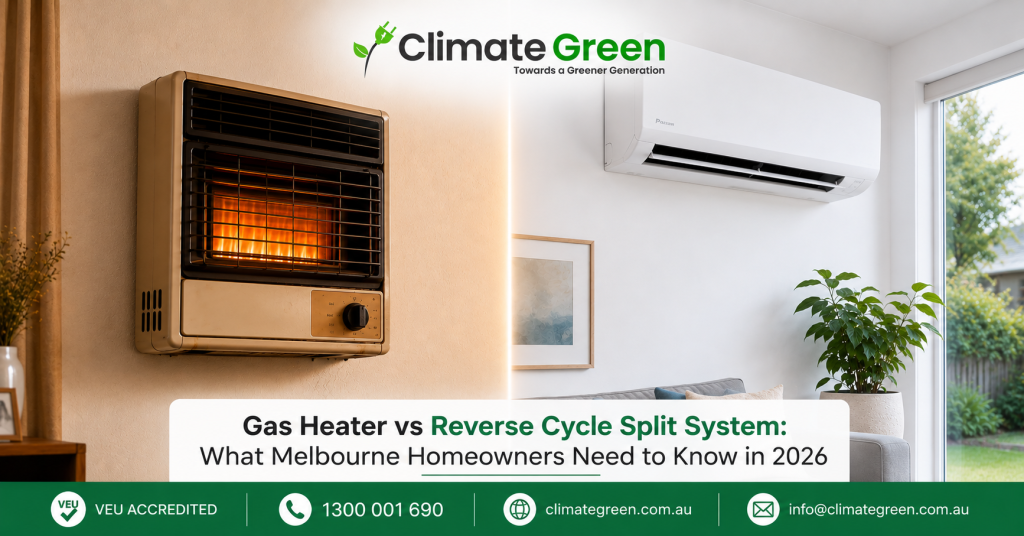
The Question Every Melbourne Homeowner Is Asking in 2026
Victoria has more ducted gas heaters per household than any other state or territory in Australia. For decades, gas was the default choice — it felt immediate, it felt powerful, and it felt affordable. But the energy landscape that made gas sensible has shifted on every dimension that matters: cost, efficiency, safety, and regulation.
The Victorian Government’s own Gas Substitution Roadmap puts the financial reality plainly: gas bills for the average Victorian household increased by over $500 in less than two years — a 35 per cent rise. That is not a blip. It reflects the structural change underway as Bass Strait reserves deplete and Victoria increasingly relies on imported LNG priced at international market rates.
At the same time, reverse cycle split systems — the electric alternative — have become dramatically more capable, more affordable, and more supported by government incentive programs. The Victorian Energy Upgrades program now offers up to $3,600 off the cost of replacing a ducted gas system with a reverse cycle equivalent, with ongoing annual savings of $500 to $600 projected by the Victorian Government itself.
This guide walks through every dimension of the comparison — efficiency, running costs, safety, indoor air quality, the VEU rebate figures, and what the upcoming legislative changes mean for Melbourne homeowners, landlords, and renters. All figures come from official government sources.
Space heating and cooling accounts for over 50% of residential energy use in Victoria. Choosing the right system is the single biggest lever a Melbourne household has over its energy bill. — energy.vic.gov.au
| ⚠️ Key Dates Every Melbourne Homeowner Should Know 1 July 2026 — Solar Victoria rebate income threshold drops from $210,000 to $150,000/year. Submit your application by 5pm 30 June 2026 if your income is between these figures. 1 January 2027 — All new homes in Victoria must be built all-electric. No new gas connections permitted in new construction. 1 March 2027 — When an existing gas heating or hot water appliance fails and cannot be repaired, it must be replaced with an efficient electric alternative. Like-for-like gas replacement will not be permitted. 1 March 2027 — Landlords must provide energy-efficient cooling in the main living area of a property at the commencement of any new lease. 1 July 2030 — Efficient electric cooling mandatory in ALL Victorian rental properties regardless of lease status. Source: energy.vic.gov.au — New electrification and efficiency standards for Victorian buildings (updated March 2026) |
How Each System Works: The Fundamental Difference
Gas Ducted Heating
A gas ducted heating system burns natural gas in a central heating unit — typically located in the roof cavity or under the floor — and pushes the resulting warm air through a network of ducts to vents in each room. The system is straightforward: combustion produces heat, a fan distributes it.
This combustion process is the source of both the system’s familiarity and its limitations. It has a hard efficiency ceiling: a gas ducted heater operating at its rated efficiency converts between 85 and 92 cents of every dollar spent on gas into useful heat. The remaining 8 to 15 cents is lost through the flue, through standing heat losses in the ducts, and through the heating unit itself. As the system ages, these losses compound. Gas ducted systems also produce only heat — there is no cooling function, meaning a separate cooling system is required to manage Melbourne’s summers.
Unflued gas heaters — portable or wall-mounted units that vent combustion products directly into the room rather than to the outside — are a different and more concerning category, addressed separately below.
Reverse Cycle Split System Air Conditioning
A reverse cycle split system does not burn anything. Instead, it uses a refrigeration cycle — the same physical mechanism found in a household refrigerator — to move thermal energy from one location to another. In winter, it extracts heat from the outdoor air and transfers it inside. In summer, it reverses the process, extracting heat from inside and expelling it outdoors.
The defining characteristic of this technology is that moving heat requires far less energy than creating it. As the Australian Government’s energy.gov.au confirms, reverse cycle air conditioners on the Australian market achieve between 300 and 600 per cent efficiency — meaning that for every unit of electrical energy consumed, the system delivers three to six units of heating or cooling energy. This is not a rounding error or marketing claim. It is the physical consequence of transferring heat rather than generating it.
Solar Victoria, on its Reverse Cycle Air Conditioners buyers guide, puts the comparison in direct terms: each unit of electricity in a reverse cycle system can generate up to six units of heat, whereas other electric heaters — resistance elements — can never exceed one unit of heat per unit of electricity. A system more than 15 years old will typically consume more than three times the energy of a modern reverse cycle unit.
Sources: energy.gov.au — Heating and cooling; solar.vic.gov.au — Home Heating and Cooling Upgrades Buyers Guide: Section 1 — About reverse-cycle air conditioners
The Efficiency Numbers: What Government Data Actually Shows
The efficiency gap between gas ducted heating and a modern reverse cycle split system is not marginal — it is structural. No amount of maintenance or optimisation can close it, because the two systems operate on different physical principles.
| System Type | Heating Efficiency | Cooling Function | What Powers It | Victorian Phase-Out |
| Gas ducted heating | 85–92% thermal efficiency | No — heating only | Natural gas (fossil fuel) | Mandatory end-of-life replacement with electric from 1 March 2027 |
| Gas space heater (flued) | 85–92% thermal efficiency | No | Natural gas or LPG | End-of-life replacement with electric from 1 March 2027 |
| Unflued gas heater | Heat released into room | No | Natural gas | Banned in many Victorian schools, childcare centres and healthcare settings since 2008 |
| Electric resistance heater | 100% (maximum possible — creates heat directly) | No | Electricity | No phase-out — but most expensive electric option to run |
| Reverse cycle split system | 300–600% equivalent (COP 3.0–6.0) | Yes — heating and cooling in one unit | Electricity | Not being phased out — preferred electric alternative for government rebates |
| Reverse cycle multi-split | 300–600% equivalent | Yes — multiple rooms from one outdoor unit | Electricity | Not being phased out — eligible for VEU program |
| Reverse cycle ducted | 300–600% equivalent | Yes — whole home heating and cooling | Electricity | Not being phased out — eligible for VEU program |
Efficiency data: energy.gov.au — Heating and cooling. System types under VEU: energy.vic.gov.au — Choosing the right reverse cycle air conditioner. Phase-out timelines: energy.vic.gov.au — New electrification and efficiency standards
A ducted gas heater operating at 90% efficiency and a reverse cycle system operating at a COP of 3.5 (350% efficiency) are not competing on equal terms — the split system delivers almost four times the useful heat per dollar of energy cost. This is the fundamental reason why switching saves money from day one.
Running Cost Comparison: What Victorian Government Data Shows
Victoria’s Gas Substitution Roadmap and the energy.vic.gov.au news analysis of VEU program outcomes both publish specific, household-scale cost figures. These are not modelled estimates — they reflect measured outcomes from actual program installations.
| Upgrade Scenario | VEU Rebate on Installation | Projected Annual Bill Saving | Source |
| Replace single gas space heater with reverse cycle | ~$900 typical installation discount | $150–$200 per year | energy.vic.gov.au — Evolving energy savings support for our future |
| Replace gas ducted system with reverse cycle ducted | ~$3,600 typical installation discount | $500–$600 per year | energy.vic.gov.au — Evolving energy savings support for our future |
| Replace gas space heater — VEU headline figure | Up to $1,610 discount on installation | Up to $460 per year | energy.vic.gov.au — Electrification and efficiency standards |
| Disconnect from gas entirely (if heating is last gas appliance) | See above rebates | ~$350–$400 per year in gas supply charge savings alone | energy.vic.gov.au — Electrification and efficiency standards |
The gas supply charge saving deserves particular attention. Every Victorian household connected to the gas network pays a daily supply charge regardless of how much gas they use. The Victorian Government confirms that households whose heating upgrade removes gas as their last appliance can save approximately $350 to $400 per year simply by disconnecting from the gas network — before accounting for any savings on the gas they were previously burning.
When a household replaces its gas ducted system with reverse cycle ducted heating and cooling, then replaces its gas hot water with a heat pump hot water system, and switches its gas cooktop to induction, the cumulative annual saving from eliminating the gas supply charge alone can exceed this figure. The VEU program offers discounts on each of these transitions individually.
Source: energy.vic.gov.au — Evolving energy savings support for our future; energy.vic.gov.au — New electrification and efficiency standards and regulations for Victorian buildings
Why Gas Price Trends Make the Decision Clearer Every Year
Gas pricing in Victoria is not simply a function of supply and demand in a local market. Victorian gas comes primarily from Bass Strait fields, which are progressively depleting. As domestic supply shrinks, Victoria increasingly draws on imported LNG — Liquefied Natural Gas priced at international export market rates. This structural shift is irreversible, and its effect on household bills is already visible.
The Victorian Government’s Gas Substitution Roadmap, updated in 2025, confirms the trajectory: gas bills for the average Victorian household increased by more than $500 in under two years, representing a 35 per cent rise. The roadmap describes this as a reflection of fossil gas no longer being the cheap and abundant energy source it historically was.
Electricity prices in Victoria are also not static. However, a household with rooftop solar panels can power a reverse cycle system during the day at near-zero marginal cost, and can time-shift heating and cooling loads to off-peak tariff windows. Gas offers no equivalent flexibility — you cannot generate your own gas, and you cannot schedule gas combustion to a cheaper period. The asymmetry between the two energy sources on this dimension alone is significant.
Source: energy.vic.gov.au — Gas Substitution Roadmap Charts Path to Lower Bills; energy.vic.gov.au — Victoria’s Gas Substitution Roadmap (2025 update)
Gas Heater Safety in Victoria: What Homeowners Must Know
The safety dimension of this comparison is not a marketing angle — it is backed by Victorian law, two confirmed deaths from carbon monoxide poisoning, and a regulatory response from Energy Safe Victoria that came into effect in August 2022.
The Open-Flued Gas Heater Ban
An open-flued gas space heater uses a flue — a pipe or duct — to vent combustion products to the outdoors. In modern, well-sealed homes, a phenomenon called negative pressure can reverse the expected airflow through the flue, drawing combustion products — including carbon monoxide — back into the living space rather than expelling them.
Energy Safe Victoria describes this mechanism clearly: negative pressure can occur when the home is not ventilated sufficiently and an exhaust fan is running — for example, a kitchen or bathroom fan, or a clothes dryer. Under these conditions, the flue can draw air into the home rather than expelling it, bringing dangerous gases with it.
The human consequences of this risk are documented. The Victorian Government’s energy.vic.gov.au confirmed that the regulation change was triggered directly by the death of Sonia Sofianopoulos in July 2017, and the deaths of Chase and Tyler Robinson in May 2010, all from carbon monoxide poisoning caused by open-flued gas space heaters.
From 1 August 2022, open-flued gas space heaters that do not meet the new safety standards — specifically, that do not include an automatic shutdown device that activates when combustion products spill into the living space — cannot be sold or installed anywhere in Victoria. This ban covers new and second-hand heaters. Energy Safe Victoria has issued specific safety alerts for several heater models that remain in service and pose ongoing risk.
Source: energysafe.vic.gov.au — Open-flued heaters and shutdown features; energy.vic.gov.au — Gas heater safety; Consumer Affairs Victoria — Open-flue heater ban
| 🚨 Gas Heater Safety Checks You Must Carry Out Check whether your gas heater model appears on Energy Safe Victoria’s safety alerts list at energysafe.vic.gov.au/community-safety/energy-safety-guides/home-safety/heating-your-home-gas Have any gas heater serviced at least every 2 years by a licensed gasfitter, as recommended by Better Health Channel (betterhealth.vic.gov.au). If health problems — headaches, dizziness, nausea, shortness of breath — worsen when the gas heater is operating, turn it off immediately and contact a licensed gasfitter. Never operate an open-flued gas heater with exhaust fans running simultaneously — kitchen, bathroom, or clothes dryer exhaust fans create negative pressure that can reverse flue airflow. Carbon monoxide is colourless and odourless. A CO alarm is recommended but is not a substitute for regular servicing and correct installation. Source: EPA Victoria — Carbon monoxide (epa.vic.gov.au) |
Unflued Gas Heaters: A Separate and More Serious Concern
Unflued gas heaters — which include portable LPG heaters and some wall-mounted natural gas models — release all combustion products directly into the room being heated. The Better Health Channel, maintained by the Victorian Department of Health, states that unflued gas heaters release water vapour, nitrogen dioxide, and other combustion by-products that can exacerbate respiratory conditions.
The health.vic.gov.au report of the Chief Health Officer of Victoria confirmed the public health basis for restrictions: unflued gas heating is banned in vulnerable-use settings in Victoria including childcare centres, schools, universities, community health centres, residential care services, and hospitals — a restriction in place since 2008, specifically because of the respiratory health risks associated with nitrogen dioxide and other combustion products.
WorkSafe ACT’s published guidance on unflued gas heaters — drawing on the same science — confirms that nitrogen dioxide is odourless and invisible at harmful concentrations, making it particularly dangerous, and that unflued heaters increase the incidence of respiratory problems in building occupants. Children and people with asthma are identified as particularly susceptible.
Reverse cycle split systems produce no combustion by-products of any kind. They move air rather than burning fuel, meaning there is no carbon monoxide risk, no nitrogen dioxide exposure, and no requirement for ventilation to manage indoor air quality from the heating or cooling appliance itself.
Sources: health.vic.gov.au — Healthy indoor environments (Chief Health Officer Report 2018); betterhealth.vic.gov.au — Gas heating health and safety issues; epa.vic.gov.au — Carbon monoxide; energysafe.vic.gov.au — Heating your home with gas
Types of Reverse Cycle Systems Available in Victoria
The Victorian Energy Upgrades program recognises three configurations of reverse cycle air conditioning, each suited to different household profiles. Understanding which type is right for your home is part of Climate Green’s free property assessment process.
| System Type | Configuration | Best Suited To | VEU Eligible? |
| Single-split | One outdoor unit connected to one indoor unit | Single room or open-plan area; apartments; targeted room heating/cooling | Yes |
| Multi-split | One outdoor unit connected to two or more indoor units | Multiple rooms from a single outdoor installation; avoids multiple compressors | Yes |
| Ducted reverse cycle | One central outdoor unit connected to multiple rooms via ducts and ceiling vents | Whole-home heating and cooling; direct replacement for ducted gas systems | Yes |
For households replacing a gas ducted system, a ducted reverse cycle system provides the closest functional equivalent: the same whole-home coverage and centralised control, but with the efficiency and cooling capability of reverse cycle technology. The VEU rebate for this specific upgrade — up to $3,600 off installation — reflects the scale of energy savings the program is designed to capture.
For households replacing a single gas space heater in a living room or bedroom, a single-split or multi-split system is typically the most cost-effective approach. The multi-split configuration is particularly popular in Melbourne’s growing suburbs, where a single outdoor unit serves a living room, master bedroom, and one or two additional rooms without requiring ductwork through the ceiling cavity.
Source: energy.vic.gov.au — Choosing the right reverse cycle air conditioner (VEU program guide)
The VEU Rebate: What You Actually Receive in 2026
The Victorian Energy Upgrades program discount is not a reimbursement you wait to receive after installation — it is an upfront reduction on your invoice, delivered by your VEU-accredited installer at the point of sale. Climate Green is VEU-accredited and applies this discount directly to every eligible installation.
The discount is generated through Victorian Energy Efficiency Certificates (VEECs). When an accredited installer replaces an inefficient gas heater with an approved reverse cycle system, they generate VEECs representing the estimated lifetime energy saving of that upgrade. Those certificates are sold on the market, and the proceeds are passed to you as a discount. There is no application, no portal, and no waiting period. The discount appears on your installation invoice.
Key VEU eligibility requirements for heating and cooling upgrades in 2026:
- The property must be located in Victoria
- The property must be at least 2 years old
- The existing system being replaced must be an inefficient gas or electric heater
- The installed reverse cycle system must appear on the ESC approved product register
- Installation must be completed by a VEU-accredited provider — Climate Green holds this accreditation
- From 31 March 2025, all products installed under the VEU program must carry a minimum 5-year warranty
- No income test, no property value cap — open to all Victorian households and rental properties
Source: energy.vic.gov.au — Victorian Energy Upgrades for homes; ESC — VEU program requirements
There is no income test for the VEU discount. Whether you own your home outright, have a mortgage, or are a landlord with rental properties, if the installation is in Victoria and the product is approved, the discount applies. Climate Green handles the paperwork.
What the 2027 Changes Mean for Victorian Landlords
Victorian landlords face a clear and legislated timeline. The energy.vic.gov.au electrification standards page sets out the obligations in plain terms, and Climate Green summarises them here for Melbourne landlords planning their property upgrade schedule.
| Date | Obligation | What It Means in Practice |
| 1 March 2027 | When a gas heating or hot water appliance fails and cannot be repaired, it must be replaced with an efficient electric alternative | A gas ducted heater that breaks down in a rental property from this date must be replaced with a reverse cycle system — not another gas unit |
| 1 March 2027 | At the start of a new lease, energy-efficient cooling must be provided in the main living area | Any new tenancy agreement from this date requires a compliant reverse cycle system (heating and cooling) in the main living room |
| 1 March 2027 | At the start of a new lease, ceiling insulation required where absent | Applies to properties without existing ceiling insulation |
| 1 July 2027 | At the start of a new lease, draught proofing required on external doors and windows | Excludes properties with open-flued or flueless gas appliances for safety reasons |
| 1 July 2030 | Efficient electric cooling mandatory in ALL Victorian rental properties | Applies regardless of lease status — no transitional period after this date |
The financial case for landlords acting before these deadlines is compelling. The Victorian Government’s own data, published at energy.vic.gov.au, shows that energy-efficient houses in Melbourne achieve up to $197,000 more in sale price than non-energy-efficient equivalents, and energy-efficient units achieve up to $95,000 more, based on Domain Sustainability Report data from 2025. Installing a new reverse cycle system before the legal deadline, while the VEU discount is available, is a lower-cost path than a forced emergency replacement under the obligations of a failing tenancy.
Source: energy.vic.gov.au — Energy efficiency for rental properties in Victoria (February 2026 update); energy.vic.gov.au — New electrification and efficiency standards
System Sizing: Getting It Right for Your Melbourne Home
Reverse cycle system sizing is measured in kilowatts of capacity. An undersized system runs continuously without reaching the target temperature on the coldest Melbourne days. An oversized system short-cycles — switching on and off rapidly — which wastes energy and creates comfort issues.
Solar Victoria’s buyers guide for heating and cooling provides a practical starting reference: an installed 3.5 kW reverse cycle unit is suited to a modest-sized living room and carries an average installed cost of around $1,700. This is a starting reference, not a universal specification. Actual sizing depends on the room’s volume, insulation quality, window area and orientation, ceiling height, and whether the home is in metropolitan Melbourne or a cooler regional location like Ballarat or Bendigo.
For homes replacing a gas ducted system — where the objective is whole-home heating and cooling — a ducted reverse cycle system must be sized to handle the full load of the dwelling. Climate Green’s assessment takes into account the home’s floor area, thermal envelope, zoning requirements, and the Victorian climate zone to specify the right capacity.
Solar Victoria’s guide also notes that a home in a cooler inland climate like Ballarat has meaningfully greater heating requirements than a comparable property in inner Melbourne, and that the correct system for Ballarat will be different from the correct system for St Kilda — even if the properties are the same size.
Source: solar.vic.gov.au — Section 2: What to consider when choosing the right energy-efficient reverse cycle air conditioner
Pairing a Reverse Cycle System with Rooftop Solar Panels
One of the most significant financial advantages of a reverse cycle split system over gas is its compatibility with rooftop solar generation. A gas heater cannot run on solar electricity — it burns gas regardless of whether your panels are generating at full capacity. A reverse cycle system can.
With a solar-coupled reverse cycle system and a programmable timer or smart controller, Melbourne homeowners can schedule the bulk of their heating and pre-cooling to run during the solar generation window — typically between 9am and 3pm on clear days. Pre-heating the home’s thermal mass before cold evenings arrive, and pre-cooling before hot afternoons, reduces the energy draw during peak tariff periods when grid electricity is most expensive.
Adding a battery storage system extends this further. Surplus solar generation stored during the day can power the reverse cycle system into the evening without drawing from the grid. Climate Green installs solar panels, battery storage, and reverse cycle systems as integrated packages, designed around each household’s energy profile.
Complete Head-to-Head Comparison: Gas Ducted vs Reverse Cycle
| Factor | Gas Ducted Heating | Reverse Cycle Split/Ducted System |
| Heating function | Yes | Yes |
| Cooling function | No — heating only | Yes — one system for both seasons |
| Efficiency (heating) | 85–92% thermal efficiency | 300–600% equivalent (COP 3.0–6.0) |
| Running cost trajectory | Rising — gas prices up 35% in 2 years | Stable/falling — compatible with own solar generation |
| Government rebate | No — gas systems do not attract VEU rebates | Yes — up to $3,600 VEU discount for ducted replacement |
| Carbon monoxide risk | Yes — flued systems can spill CO under negative pressure | None — no combustion involved |
| Indoor air quality impact | Combustion produces CO₂, CO, NOx and water vapour inside or via flue | No combustion products — air quality neutral |
| Victorian phase-out | Must replace with electric when next failing from 1 March 2027 | Fully compliant with all current and future regulations |
| New home installation | Banned in new homes from 1 January 2027 | Preferred technology for new construction |
| Rental property compliance | Does not meet 2027 minimum standards | Meets all current and 2027+ minimum standards |
| Compatible with rooftop solar | No | Yes — can run on self-generated solar electricity |
| Zoned temperature control | Whole-home only (ducted) | Yes — multi-split or zoned ducted configurations |
| Servicing requirement | Every 2 years minimum — licensed gasfitter required | Filter cleaning by homeowner; infrequent full-service |
| Typical system lifespan | 15–20 years (older systems use 3x more energy than modern equivalent) | 15–20 years with maintenance |
Sources: energy.gov.au — Heating and cooling; solar.vic.gov.au — Buyers Guide Section 1; energy.vic.gov.au — Electrification standards; energysafe.vic.gov.au — Open-flued heaters; energy.vic.gov.au — Gas Substitution Roadmap
Frequently Asked Questions
Does a reverse cycle system work effectively in Melbourne’s cold winters?
Yes. Modern reverse cycle systems on the Australian market are rated to operate efficiently in ambient temperatures down to minus 15 degrees Celsius on some premium models — well below anything Melbourne experiences. Solar Victoria confirms that each unit of electricity in a reverse cycle system generates up to 6 units of heat, even in cold conditions. A 15-year-old reverse cycle system would use more than three times the energy of a current model — so if your existing system is ageing, upgrading to a current-generation unit also improves cold-weather performance.
What is the actual VEU rebate amount for replacing a gas ducted system?
The Victorian Government’s energy.vic.gov.au publishes that a household replacing a gas ducted system with a reverse cycle equivalent typically receives approximately $3,600 off the installation cost, saving $500 to $600 per year on ongoing energy costs. For a single gas space heater replacement, the typical discount is approximately $900, with annual savings of $150 to $200. These are indicative figures — the actual VEEC value varies with current market prices. Climate Green will provide the exact discount applicable to your installation in your written quote.
I have a gas ducted system. Can I just add split systems and keep the gas for backup?
You can, but it is not generally the most cost-effective approach. Running two parallel systems — a gas ducted network and reverse cycle units — means paying the daily gas supply charge whether or not you use the gas heater, and maintaining two systems. Most Melbourne households find it more economical to transition to a single reverse cycle system that handles both heating and cooling, eliminating the gas supply charge entirely if gas is no longer used for any other appliance.
My landlord has a gas ducted heater in my rental. Does this affect my rights?
From 1 March 2027, a landlord whose gas ducted system fails and cannot be repaired must replace it with an efficient electric reverse cycle system rather than a gas equivalent. From the same date, any new lease must include energy-efficient cooling in the main living area. From 1 July 2030, all Victorian rental properties must provide efficient electric cooling regardless of lease status. If you are a tenant with concerns about your heating and cooling, the Victorian Government’s consumer.vic.gov.au provides guidance on minimum rental standards.
Is my open-flued gas heater legal to keep using?
Open-flued gas space heaters that meet the new safety standards — specifically, those with an automatic shutdown device that prevents CO from spilling into the living space — remain legal to use and service. Those without this safety feature cannot be sold, installed, or supplied as of 1 August 2022. Energy Safe Victoria has issued safety alerts for specific models known to pose risks. Check energysafe.vic.gov.au to confirm whether your model is on the alert list, and have your heater serviced every two years by a licensed gasfitter.
Can Climate Green install a reverse cycle system across Melbourne’s outer suburbs and regional Victoria?
Yes. Climate Green’s installation team operates across metropolitan Melbourne — including Werribee, Tarneit, Craigieburn, Pakenham, Berwick, Frankston, Dandenong, Box Hill, and Ringwood — as well as regional Victorian cities including Geelong, Ballarat, Bendigo, and Moe. All installations are completed by VBA-registered technicians and licensed electricians, and include both mandatory compliance certificates.
How does Climate Green price a reverse cycle installation, and what does the VEU discount actually look like?
Climate Green provides a written, itemised quote that shows the full installed system price, the VEU discount applied at invoice, and the final amount payable. You do not receive a rebate separately and wait — the discount is applied before you pay. There is no application form for the VEU discount. Call 1300 001 690 or email info@climategreen.com.au to arrange a free property assessment and receive a written quote.
Further Reading from Climate Green
Related articles on heating and cooling upgrades, VEU rebates, and energy efficiency for Melbourne and Victorian homeowners:
Heating & Cooling Installation — Climate Green
- Reverse Cycle Heating vs Gas Ducted Heating — Climate Green Melbourne
- Why You Should Invest in Energy-Efficient Heating and Cooling Systems
- The Future of Comfort: Energy-Efficient HVAC Systems in Melbourne
- Discover the Benefits of Heating and Cooling System Installation by Climate Green
- Air Conditioning Compliance Victoria 2026: What Every Homeowner Must Know
VEU Program & Rebates
- Victorian Energy Upgrades (VEU) Program for Homes
- Who Qualifies for the Victorian Energy Upgrades Program?
- Advantages of the VEU Program for Melbourne Homes
- Are Heat Pumps and AC Eligible Products Under the VEU Program?
- The Role of VEU-Accredited Providers in Promoting Energy Efficiency in Melbourne
Related Energy Upgrade Articles
- Heat Pump Hot Water Systems Melbourne & Victoria: Complete Guide
- Victorian Heat Pump Hot Water Rebate 2026: The Complete Guide
- Solar Grants & Rebates for Victorian Homeowners: Complete 2026 Guide
- Cheaper Home Batteries Program Victoria
- How Solar Batteries Store Energy for Your Home
Government Sources Referenced in This Article
All facts, figures, rebate amounts, and regulatory requirements cited in this article are sourced from official Australian and Victorian Government publications:
- energy.gov.au — Heating and cooling (reverse cycle air conditioner efficiency: 300–600%)
- solar.vic.gov.au — Home Heating and Cooling Upgrades Buyers Guide (Section 1 and Section 2)
- energy.vic.gov.au — Choosing the right reverse cycle air conditioner (VEU program)
- energy.vic.gov.au — Evolving energy savings support for our future (rebate savings data)
- energy.vic.gov.au — New electrification and efficiency standards for Victorian buildings
- energy.vic.gov.au — Energy efficiency for rental properties in Victoria
- energy.vic.gov.au — Gas Substitution Roadmap (35% gas price increase, $500+ rise in under 2 years)
- energy.vic.gov.au — Gas heater safety (CO poisoning deaths, August 2022 regulations)
- energysafe.vic.gov.au — Open-flued heaters and shutdown features (ban from 1 August 2022)
- energysafe.vic.gov.au — Heating your home with gas (safety guidance)
- betterhealth.vic.gov.au — Gas heating health and safety issues
- health.vic.gov.au — Healthy indoor environments (unflued gas heater restrictions since 2008)
- epa.vic.gov.au — Carbon monoxide (indoor air quality and gas heater risk)
Last updated by Climate Green: June 2026. Rebate values and regulatory requirements are subject to change. Verify current figures at energy.vic.gov.au and energysafe.vic.gov.au, or call Climate Green on 1300 001 690 for current personalised advice.
| Get Your Free Heating & Cooling Assessment Today Climate Green | VEU-Accredited Provider | Melbourne & All of Victoria 📞 1300 001 690 📧 info@climategreen.com.au 🌐 www.climategreen.com.au Melbourne, Geelong, Ballarat, Bendigo, Frankston, Dandenong, Werribee & regional Victoria |