Solar Grants for Victorian Homeowners: The Complete Mid-2026 Guide
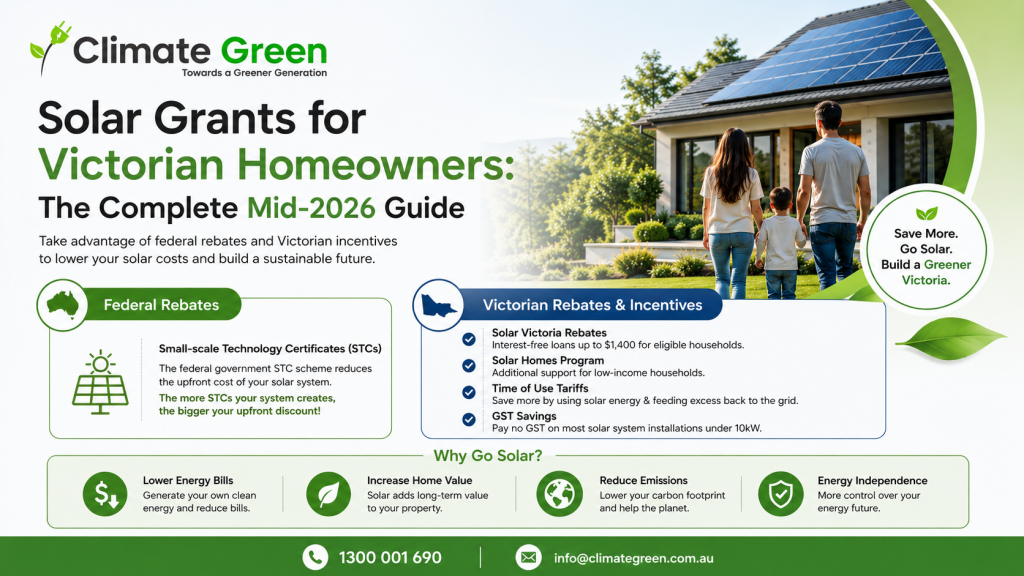
solar grants for homeowners Victoria 2026 – Blog By Climate Green
| ⚠️ Act Before 30 June 2026 — Solar Victoria Income Threshold Changing From 1 July 2026, the combined household income limit for Solar Victoria’s solar panel (PV) rebate drops from $210,000 to $150,000 per year. If your combined household income is between $150,000 and $210,000, you must submit your FULL application — with all documents — through the Service Victoria portal by 5pm on 30 June 2026. Solar Victoria will not consider saved applications or applications that time out. You must click ‘Submit’. After this date, your application will be assessed under the new $150,000 threshold. Source: solar.vic.gov.au/solar-panel-rebate (updated 1 June 2026) |
Introduction: Why Mid-2026 Is a Critical Window for Solar in Victoria
Australia is in the middle of one of the most significant periods of household energy transition in its history. Electricity prices remain elevated, the minimum solar feed-in tariff in Victoria has declined substantially, and a new generation of federal and state rebate programs is reshaping the economics of rooftop solar and battery storage.
Victorian homeowners currently have access to three distinct government programs that can be stacked together to dramatically reduce the upfront cost of going solar: the federal Small-scale Renewable Energy Scheme (SRES), which delivers a discount through Small-scale Technology Certificates (STCs); the federal Cheaper Home Batteries Program, which applies the same STC mechanism to home battery storage; and the Household Energy Upgrades Fund (HEUF), a $1 billion federal program offering discounted loans through participating lenders.
On top of these federal programs, eligible Victorian homeowners can access the Solar Victoria solar panel rebate of up to $1,400 — with an interest-free loan option to match. This guide explains exactly how each program works, who is eligible, what has changed in 2026, and how Climate Green helps Melbourne and Victorian households access every dollar they are entitled to.
“More rebates are released each month. Solar Victoria has approved more than 500,000 rebates and loans since 2018 — a major milestone confirmed by Solar Victoria in 2026.” — solar.vic.gov.au
Program 1: The Small-Scale Renewable Energy Scheme (SRES) — How STCs Work
The Small-scale Renewable Energy Scheme (SRES) is the foundational federal solar incentive for Australian homeowners and small businesses. It sits under the Renewable Energy Target (RET) and is administered by the Clean Energy Regulator (CER). The scheme was introduced in 2011 and is legislated to end on 31 December 2030.
The SRES operates through Small-scale Technology Certificates (STCs). When you install an eligible solar PV system, solar water heater, or heat pump, your system is entitled to create a number of STCs. Each STC represents one megawatt hour (MWh) of renewable electricity generated, stored, or displaced by an eligible system — as confirmed by the Clean Energy Regulator at cer.gov.au.
How the STC Discount Reaches You
Most homeowners never directly handle STCs. Instead, you assign your right to create STCs to a registered agent — typically your installer. The installer creates and sells the STCs on your behalf, then passes the value back to you as an upfront discount on your installation invoice. This means the ‘solar rebate’ you see on your quote is the STC discount applied at point of sale.
Alternatively, you can create and trade STCs yourself through the Clean Energy Regulator’s REC Registry — either on the open market or through the STC Clearing House, where STCs can be sold at a fixed price of $40 per certificate. However, as the Clean Energy Regulator notes, this process involves additional administration, and most households choose to assign the right to their installer for simplicity.
Source: Clean Energy Regulator — Small-scale technology certificates (cer.gov.au/schemes/renewable-energy-target/small-scale-renewable-energy-scheme/small-scale-technology-certificates)
The Deeming Period — Why 2026 Is Not 2020
The number of STCs your system generates is calculated using a ‘deeming period’ — an estimate of how many years of renewable energy generation the system will be credited for, running to the end of the scheme in December 2030. The Clean Energy Regulator confirms that since 2017, the deeming period has reduced by one year annually, gradually reducing the number of STCs per installation until the scheme ends in 2030.
For systems installed in 2026, the deeming period is 4 years (covering 2026–2030). For systems installed in 2027, it will be 3 years. This means every year you delay, your system generates fewer STCs and your upfront discount shrinks — typically by around 4–5% per year according to independent analysis.
| Year of Installation | Deeming Period | Relative STC Entitlement |
| 2024 | 6 years | Higher — more certificates per system |
| 2025 | 5 years | Medium-high |
| 2026 (now) | 4 years | Medium — act now to secure current value |
| 2027 | 3 years | Lower — discount reduces further |
| 2028 | 2 years | Significantly reduced |
| 2029 | 1 year | Minimal discount |
| 2030 and beyond | Scheme ends | No STCs available |
Source: Clean Energy Regulator — STC Projections report (January 2026, Jacobs); cer.gov.au — Calculate small-scale technology certificate entitlements
Geographic Zones — Why Location Affects Your STC Value
The number of STCs a solar system generates also depends on the geographic zone in which it is installed. The Clean Energy Regulator publishes postcode zone ratings for solar panel systems and solar water heater/heat pump systems in separate documents available at cer.gov.au. There are four zones in Australia based on solar irradiance levels — the higher the zone number, the lower the solar resource and the fewer STCs generated.
Melbourne and most of Victoria fall in Zone 3 or Zone 4. Postcode zone ratings are published by the Clean Energy Regulator and are used directly in the official STC calculator at rec-registry.gov.au. You can use this tool to calculate the exact number of STCs your system would generate before committing to an installation.
Source: Clean Energy Regulator — Postcode zone ratings and zones for solar panel systems (PDF, cer.gov.au); REC Registry STC Calculator (rec-registry.gov.au)
What Systems Are Eligible for STCs?
The Clean Energy Regulator confirms the following small-scale renewable energy systems are eligible to create STCs:
- Solar photovoltaic (PV) systems — rooftop and ground-mounted, up to 100 kW
- Solar water heaters — systems that use solar collectors to heat water
- Air source heat pumps — used for water heating (including heat pump hot water systems)
- Small-scale wind systems — eligible but negligible in residential use
- Small-scale hydro systems — eligible but negligible in residential use
- Solar batteries — eligible under the expanded SRES through the Cheaper Home Batteries Program (from 1 July 2025)
Systems must be installed by a Clean Energy Council (CEC) accredited installer and must use CEC-approved products. Systems above 100 kW in generation capacity are classified as large-scale power stations and fall under the Large-scale Renewable Energy Target, not the SRES.
Source: Clean Energy Regulator — Small-scale technology certificates; Information for householders (cer.gov.au/schemes/renewable-energy-target/information-householders)
Program 2: The Cheaper Home Batteries Program — The Federal Battery Rebate
The Cheaper Home Batteries Program (CHBP) is a $7.2 billion Australian Government program that expands the Small-scale Renewable Energy Scheme to include eligible home battery storage systems. It launched on 1 July 2025 and is administered by the Clean Energy Regulator and the Department of Climate Change, Energy, the Environment and Water (DCCEEW).
The Department of Climate Change, Energy, the Environment and Water confirms that Australian households, businesses and community organisations can get a discount of approximately 30% on the upfront cost of installing eligible small-scale battery systems ranging from 5 kWh to 100 kWh in nominal capacity.
Source: DCCEEW — Cheaper Home Batteries Program (dcceew.gov.au/energy/programs/cheaper-home-batteries); confirmed via the Renewable Energy (Electricity) Regulations 2001 as amended with changes commencing 1 May 2026
How the Battery Rebate Works
Like solar STCs, the battery rebate operates through the STC mechanism. Eligible batteries generate STCs based on their usable capacity. Your accredited installer claims these STCs and deducts the value from your invoice as an upfront discount. The Department confirms that consumers generally do not apply directly to the government or the Clean Energy Regulator — the discount is applied at point of sale.
The government separately purchases STCs created from solar batteries. As the Clean Energy Regulator confirms: ‘The Department of Climate Change, Energy, the Environment and Water purchases STCs equivalent to the amount of solar battery STCs created’ — meaning battery STCs are not included in the general small-scale technology percentage and are instead government-funded directly.
Source: Clean Energy Regulator — Small-scale technology certificates (cer.gov.au); 2026 Small-scale Technology Percentage calculation (cer.gov.au — STP 2026)
Key Changes from 1 May 2026
The Cheaper Home Batteries Program underwent significant structural changes on 1 May 2026, confirmed by both DCCEEW and the Clean Energy Regulator. The Renewable Energy (Electricity) Regulations 2001 were amended to reflect these changes. Key changes include:
- A tiered STC factor structure was introduced — the rebate now strongly favours batteries in the 5–14 kWh range for typical residential use
- The rebate for batteries above 14 kWh of usable capacity reduces at a significantly steeper rate than before 1 May 2026
- The STC discount factor now steps down every six months (rather than annually) until 2030 — reflecting falling battery prices
- The $7.2 billion program budget (expanded from the initial ~$2.3 billion) ensures the program continues through to 2030
- The program was originally attracting over 1,500 battery installations per day nationally by early 2026 — more than seven times the pre-program baseline of ~200 per day
Source: DCCEEW — Changes to the Cheaper Home Batteries Program (dcceew.gov.au); Clean Energy Regulator — 2026 STC Projections (Jacobs, January 2026): ‘The high scenario was used to capture the expected increase in demand for small-scale solar installations due to the Cheaper Home Batteries Program’
Eligibility Requirements for the Battery Rebate
To access the Cheaper Home Batteries Program discount, the following criteria must be met:
- The battery must be installed at a residential property, small business, or community facility (such as a sports club, library, or community centre) in Australia
- The battery must be on the Clean Energy Council’s approved product list
- The battery must have a nominal capacity of between 5 kWh and 100 kWh
- Only the first 50 kWh of usable capacity is eligible for the STC discount — capacity above 50 kWh receives no rebate
- The battery must be VPP (Virtual Power Plant) capable — though you are not required to join a VPP
- The discount applies once per electricity meter — owners of multiple eligible properties may claim separately at each
- There is no means test or income limit for the battery rebate
- The eligible install date is defined as the date the Certificate of Electrical Compliance is issued — systems installed on or after 1 July 2025 are eligible
Source: DCCEEW — Cheaper Home Batteries Program eligibility; Solar Choice analysis of government program rules (May 2026); Clean Energy Regulator — small-scale technology certificates
There is no income test for the federal battery rebate. This makes it accessible to all Victorian households regardless of income level — unlike the Solar Victoria solar panel rebate, which has income limits.
Program 3: The Household Energy Upgrades Fund (HEUF) — Discounted Loans
The Household Energy Upgrades Fund (HEUF) is a $1 billion Australian Government program delivered through the Clean Energy Finance Corporation (CEFC). Rather than a direct rebate, the HEUF works by providing concessional capital to participating lenders, who then offer discounted loan products to eligible households for energy upgrades.
The energy.gov.au website confirmed that by April 2026, the HEUF had reached more than 10,000 installations, with 7 participating lenders offering HEUF-backed finance products, and more lenders expected in 2026 and beyond.
Source: energy.gov.au — Household Energy Upgrades Fund reaches 10,000 installations (April 2026); cefc.com.au — Household Energy Upgrades Fund
What the HEUF Covers
The CEFC confirms that HEUF finance is specifically targeted at energy improvements to existing dwellings. Eligible technologies include:
- Solar PV systems and home battery storage
- Solar hot water systems and heat pump hot water systems
- Heating and cooling upgrades — including reverse cycle air conditioners
- Double-glazed windows and insulation
- EV chargers
- Other energy efficiency improvements
The CEFC notes that a broad approach to eligible technologies provides flexibility for borrowers while creating scope for emerging technology solutions that reduce household emissions.
Source: CEFC — Household Energy Upgrades Fund (cefc.com.au/where-we-invest/special-investment-programs/household-energy-upgrades-fund/)
Participating Lenders and Loan Terms (Mid-2026)
The energy.gov.au website confirmed that as at April 2026, participating HEUF lenders include the Commonwealth Bank of Australia, Westpac, Bank Australia, ING Australia, Brighte, Plenti, and Starling Energy Group (trading as Plico). The CEFC does not provide loans directly to individual borrowers — interested households contact participating lenders directly.
Loan terms vary by lender. Examples of confirmed HEUF products include:
- Brighte HEUF Discounted Green Loan: introductory rate of 6.99%, loan terms of 2 to 10 years, available for $2,000 to $55,000 — confirmed by energy.gov.au (November 2025)
- ING Green Energy Upgrade Loan: fixed rate of 3.74% for eligible customers — confirmed by energy.gov.au
- Bank Australia Clean Energy Home Loan: variable rate of 5.38% for the first 5 years — confirmed by energy.gov.au (December 2024)
- Westpac Sustainable Upgrades Home Loan: available to eligible home loan customers — confirmed by energy.gov.au
Source: energy.gov.au — $40 million to support cheaper finance (Nov 2025); Third lender announced for home energy upgrade loans; $50 million to support cheaper finance (Dec 2024); More home energy upgrade loans available
The HEUF complements rather than replaces the STC discount and Solar Victoria rebate. Victorian homeowners can use HEUF finance to cover the net cost after rebates are applied — meaning you may be able to install solar and battery with little or no money down, repaying the remainder through low-rate monthly instalments.
Program 4: Solar Victoria Solar Panel Rebate — State Program
In addition to the three federal programs above, eligible Victorian homeowners can access a state-level solar panel rebate through Solar Victoria’s Solar Homes Program. This program is distinct from the STC scheme and is funded by the Victorian Government.
Solar Victoria confirmed on 1 June 2026 that the Solar Homes Program has now approved more than 500,000 rebates and loans since launching in 2018 — a program milestone that demonstrates the scale of Victoria’s solar uptake.
Rebate Amount
- Up to $1,400 towards the cost of a solar panel (PV) system for eligible owner-occupiers
- The rebate is also available for homes under construction and eligible rental properties
- An interest-free loan of up to $1,400 is available to match the rebate, repayable monthly over 4 years
- From 1 May 2026, the interest-free loan must be selected at the time of application (not after approval)
- Loan repayments are $29.17 per month for a $1,400 loan over 4 years, automatically debited from your bank account
Source: solar.vic.gov.au/solar-panel-rebate (page content as at June 2026)
Eligibility Requirements (Current as at June 2026)
As a Victorian householder, you are eligible if:
- You are the owner-occupier of an existing property, or the owner of a home under construction where the system is to be installed
- The combined household taxable income of all property owners is below $210,000 per year — reducing to $150,000 per year from 1 July 2026
- The value of the property is under $3 million (for an existing home, or when construction is complete)
- The property address has not previously received a solar panel (PV) or solar battery rebate under the Solar Homes Program
- The property has not had a solar panel (PV) system installed in the last 10 years
- You use an authorised solar retailer and products from Solar Victoria’s approved product list
Special note: If you received a Solar Homes rebate or loan previously but have since moved house, you can apply at your new address as an owner-occupier if that address has not received these rebates before.
Source: solar.vic.gov.au/solar-panel-rebate (eligibility section, as updated 1 June 2026)
The Application Process — Step by Step
Solar Victoria’s application process is as follows, as published at solar.vic.gov.au:
- Read the Solar Victoria solar panel (PV) buyers guide at solar.vic.gov.au
- Contact an authorised solar retailer — Climate Green is authorised
- Select a system using products on Solar Victoria’s approved product list
- Ask for a written quote — your retailer uploads it to the Solar Victoria portal
- Wait for Solar Victoria’s email confirming the quote has been uploaded
- Obtain pre-approval to connect and export to the grid
- Upload eligibility documents — 2 forms of ID, proof of income, and property ownership proof — through the portal
- Wait for Solar Victoria to confirm your eligibility and issue your QR code
- Install the solar system within 120 days of receiving your QR code (or 270 days for homes under construction)
- Pay the net amount — total installation cost minus the rebate
- Begin repaying the interest-free loan if you opted for one
Solar Victoria makes clear: if you install your system before your eligibility is confirmed, you will not receive a rebate. Pre-approval is not optional.
Source: solar.vic.gov.au/solar-panel-rebate — Process for solar panel (PV) installations
Critical Deadline: Income Limit Drops to $150,000 from 1 July 2026
This is the most time-sensitive issue facing Victorian solar applicants in mid-2026. Solar Victoria has confirmed that from 1 July 2026, the combined household income threshold for the Solar Victoria solar panel rebate (and hot water rebate) will reduce from $210,000 per year to $150,000 per year.
| What You Must Do Before 5pm on 30 June 2026 (If Your Income Is $150,000–$210,000) 1. Contact Climate Green (1300 001 690) immediately — we will arrange your written quote and upload it to the Solar Victoria portal. 2. Once the quote is uploaded and you receive Solar Victoria’s confirmation email, log into the Service Victoria portal. 3. Complete ALL details and upload ALL required documents (2 forms of ID, proof of income, proof of property ownership). 4. Click ‘Submit’ before 5pm on 30 June 2026. 5. Saved applications and applications that time out will NOT be considered by Solar Victoria. 6. If you miss this deadline, your application will be assessed under the new $150,000 income cap — and you will not be eligible if your income is above this threshold. Source: solar.vic.gov.au/solar-panel-rebate (updated 1 June 2026) |
How These Programs Stack Together for Victorian Homeowners
The four programs above are not mutually exclusive. A Victorian homeowner installing both solar panels and a battery in mid-2026 can potentially access all of the following simultaneously:
| Program | Administered By | Type | Income Test? | Applies To |
| SRES (STCs) | Clean Energy Regulator (Federal) | Upfront discount on invoice | No | Solar PV, hot water, heat pumps |
| Cheaper Home Batteries Program | DCCEEW / Clean Energy Regulator (Federal) | Upfront discount on invoice | No | Home batteries 5–100 kWh |
| Household Energy Upgrades Fund (HEUF) | CEFC via participating lenders (Federal) | Discounted loan | No (lender criteria apply) | Solar, battery, heating/cooling, insulation |
| Solar Victoria Solar Panel Rebate | Solar Victoria (State) | Upfront rebate + optional interest-free loan | Yes — under $210,000 (under $150,000 from 1 July 2026) | Solar PV systems in Victoria |
Sources: Clean Energy Regulator (cer.gov.au); DCCEEW (dcceew.gov.au); CEFC (cefc.com.au); Solar Victoria (solar.vic.gov.au)
Climate Green is accredited to access all four programs on your behalf. We apply every available discount and manage the application process from first contact to final commission — you focus on the savings, we handle the paperwork.
Important: Solar Victoria Battery Loan Has Closed
Victorian homeowners searching for a state-level battery rebate should be aware that Solar Victoria is no longer accepting applications for the interest-free battery loan under the Solar Homes Program. Solar Victoria’s website confirms: ‘Solar Victoria is no longer taking applications for interest-free loans for the installation of a solar battery system.’
The Cheaper Home Batteries Program — a federal program — is now the primary financial support mechanism for home battery installation in Victoria. It delivers a stronger and broader discount than the previous Solar Victoria battery loan, with no income test and no application required by the homeowner.
Source: solar.vic.gov.au/solar-homes-program — Solar Homes Program page; solar.vic.gov.au/solar-battery-buyers-guide — Section 2: What incentives are available for solar battery systems?
From 1 January 2027: All New Homes in Victoria Must Be All-Electric
Solar Victoria and the Victorian Government confirm that from 1 January 2027, all new residential buildings in Victoria must be built as all-electric. This means no gas connections in new homes, and all space heating, water heating, and cooking must use electric appliances.
The solar panel (PV) rebate is explicitly available for homes under construction — Victorian homeowners building in 2026 can apply for the Solar Victoria rebate during the construction phase and take advantage of current rebate levels before the all-electric mandate begins.
Source: solar.vic.gov.au/solar-panel-rebate — Building a house section; energy.vic.gov.au — New electrification and efficiency standards and regulations for Victorian buildings
Frequently Asked Questions
Do I need to apply for the solar rebate myself?
For the federal STC discount (solar panels and batteries), no — your accredited installer applies for the certificates and deducts the value from your invoice. For the Solar Victoria solar panel rebate, you must apply through the Service Victoria portal yourself (your installer uploads the quote, but you complete the eligibility application and submit it).
Can I claim both the solar panel STC discount and the Solar Victoria rebate?
Yes. The federal STC discount and the Solar Victoria rebate are separate programs that can be claimed on the same installation. Your installer will apply the STC discount to the system price first; the Solar Victoria rebate is then applied as an additional reduction on the remaining balance.
Is there an income test for the battery rebate?
No. The Cheaper Home Batteries Program has no income test. It is available to all Australian households, businesses, and community organisations, regardless of income level, provided the technical eligibility criteria are met.
What is the difference between STCs and a rebate?
Technically, STCs are tradeable certificates, not a government rebate. However, the financial effect is the same — your installer creates the certificates, sells them, and passes the value back to you as a direct reduction on your installation invoice. The Clean Energy Regulator refers to this as a ‘point-of-sale discount’ for eligible households who assign their STC rights to a registered agent.
How long do I have to claim STCs after installation?
The Clean Energy Regulator confirms that STCs can only be created within 12 months of the installation of an eligible system. If you or your installer miss this window, the certificates cannot be created and the discount is lost.
Will the solar rebate end?
The federal SRES (STC scheme) is legislated to end on 31 December 2030. The Cheaper Home Batteries Program is funded to 2030 with annual review of discount rates. The Solar Victoria Solar Homes Program is a state program subject to Victorian Government budget decisions. Both federal programs reduce in value each year until 2030 — installing in 2026 captures a higher discount than waiting.
Can I use HEUF finance on top of STCs and Solar Victoria rebate?
Yes. The Household Energy Upgrades Fund provides discounted loans for energy upgrades — it is designed to be complementary to upfront rebates and discounts. You could apply the STC discount and Solar Victoria rebate to reduce your upfront cost, then use a HEUF-backed loan to finance any remaining balance at a discounted interest rate.
Does Climate Green handle the rebate paperwork?
Yes. As a VEU-accredited provider and Solar Victoria authorised retailer, Climate Green manages the full process for the solar panel rebate, hot water rebate, STC discount, and VEU program discounts. We upload your quote to the Solar Victoria portal, guide you through the pre-approval documentation, apply all federal STC discounts at invoice, and advise on HEUF finance options. Call 1300 001 690 or email info@climategreen.com.au to get started.
Further Reading from Climate Green
- Victorian Heat Pump Hot Water Rebate 2026: Complete Guide
- Air Conditioning Compliance Victoria 2026: Homeowner Guide
- Cheaper Home Batteries Program Victoria
- Solar Batteries Are the Smartest Upgrade in Melbourne
- Solar Battery Size Guide for Melbourne: 5kWh vs 10kWh vs 15kWh
- Do Solar Batteries Provide Power in a Blackout?
Government Sources Used in This Article
All facts are drawn exclusively from official Australian and Victorian Government sources:
- Clean Energy Regulator — Small-scale technology certificates
- Clean Energy Regulator — Calculate STC entitlements (REC Registry calculator)
- Clean Energy Regulator — 2026 Small-scale Technology Percentage
- Clean Energy Regulator — STC Projections (Jacobs, January 2026)
- DCCEEW — Cheaper Home Batteries Program
- Solar Victoria — Solar panel (PV) rebate
- Solar Victoria — Solar Homes Program
- Solar Victoria — Solar Victoria programs overview
- CEFC — Household Energy Upgrades Fund
- energy.gov.au — Household Energy Upgrades Fund reaches 10,000 installations (April 2026)
- energy.gov.au — $40 million to support cheaper finance for home energy upgrades (Nov 2025)
- energy.gov.au — Household Energy Upgrades Fund rebates page
Last updated by Climate Green: June 2026. Rebate values and eligibility criteria are subject to change. Always verify current details at cer.gov.au, dcceew.gov.au, solar.vic.gov.au, and energy.gov.au before making decisions. Call Climate Green on 1300 001 690 for personalised, current advice.
| Get Your Free Solar Assessment — Maximise Every Available Rebate Climate Green | VEU-Accredited | CEC-Approved | Melbourne & All of Victoria 📞 1300 001 690 📧 info@climategreen.com.au 🌐 www.climategreen.com.au We handle all rebate paperwork — federal and state — on your behalf |