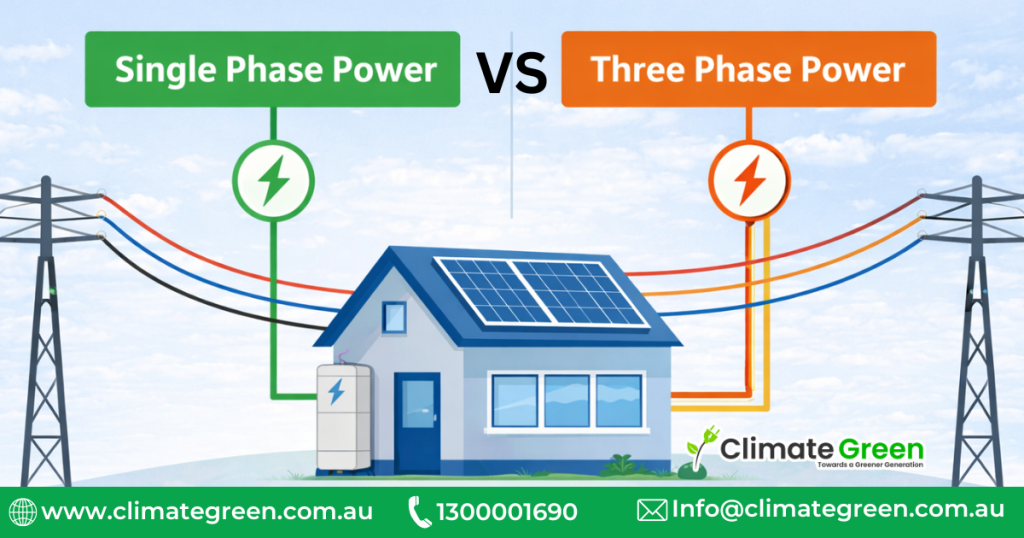
Single Phase vs Three Phase Power: What It Means for Solar, Batteries & Load Balancing in Melbourne
When planning a solar and battery installation in Melbourne, one of the most important decisions homeowners face is whether their property should use a single-phase or three-phase system. This choice directly affects system size, export capacity, battery performance, long-term savings, and future energy flexibility.
At Climate Green Melbourne, we regularly help homeowners understand how their home’s electrical configuration impacts solar performance. The right decision ensures your system is engineered for optimal output, long-term reliability, and maximum return on investment.
Understanding Single-Phase and Three-Phase Power
Most Australian homes are connected to either:
- Single-phase power (240V) – One active line supplying electricity.
- Three-phase power (415V) – Three active lines delivering power in balanced intervals.
Traditionally, smaller homes and older properties in Melbourne suburbs operate on single-phase power. Larger homes, properties with high electrical loads (ducted air conditioning, EV chargers, workshops, heat pumps), or newer developments often use three-phase power.
Quick Comparison: Single-Phase vs Three-Phase Power
| Feature | Single-Phase Power | Three-Phase Power |
|---|---|---|
| Voltage | 240V | 415V |
| Common in | Standard homes | Larger homes & high-load properties |
| Solar Export Limits (Typical in VIC)* | ~5kW per phase | ~5kW per phase (up to ~15kW total across phases) |
| Load Balancing | Limited | Balanced across 3 phases |
| Voltage Stability | Can experience voltage rise | More stable voltage control |
| Future EV Readiness | Moderate | Excellent |
| Upfront Cost | Lower | Higher |
| System Complexity | Simple | More advanced |
*Export limits vary depending on your DNSP (e.g., AusNet, United Energy, Jemena, etc.).
Single-Phase Solar Systems in Melbourne
Single-phase systems are the most common residential setup across Victoria.
Advantages
1. Lower Installation Cost
Single-phase inverters and system design are simpler, reducing upfront cost.
2. Proven and Reliable
Most residential solar systems installed in Melbourne are single-phase and have performed reliably for years.
3. Ideal for Standard Energy Usage
Homes consuming around 15–25kWh per day generally operate efficiently on single-phase systems.
4. Easier Battery Integration
Many residential batteries are designed for straightforward single-phase integration.
Limitations
- Export may be capped at 5kW.
- Voltage rise can occur in high solar-density suburbs.
- Not ideal for homes with large electrical loads across multiple circuits.
Three-Phase Solar Systems: The Modern Upgrade
Three-phase solar systems distribute energy evenly across three electrical lines. This offers clear performance advantages for larger homes or growing energy needs.
Advantages
1. Higher System Capacity
You can install larger solar systems (often 10kW–15kW+) while maintaining balanced exports.
2. Improved Voltage Stability
Three-phase systems reduce the risk of voltage rise and inverter shutdown during peak solar production.
3. Better Load Balancing
Perfect for homes with:
- Ducted heating/cooling
- Electric vehicle chargers
- Induction cooktops
- Pool pumps
- Home workshops
4. Future-Proofing Your Investment
With electrification accelerating across Victoria, three-phase systems provide long-term flexibility.
Solar & Battery Integration: What Changes?
Battery performance and integration differ between single-phase and three-phase systems.
Comparison: Battery Integration
| Aspect | Single-Phase Battery | Three-Phase Battery |
|---|---|---|
| Installation Cost | Lower | Higher |
| Backup Coverage | Typically single phase | Can support all 3 phases |
| Export Flexibility | Limited | Greater flexibility |
| Best For | Standard homes | Larger homes or high-load households |
| EV Charging Support | Moderate | Excellent |
In three-phase homes, batteries can be configured to support either one phase or all three phases depending on system design.
How to Decide for Your Melbourne Home
1. Check Your Switchboard
Your switchboard will confirm whether your home is single or three-phase. Climate Green’s team can assess this during a site inspection.
2. Review Your Energy Usage
If your daily usage exceeds 25kWh or you plan to install:
- An EV charger
- Heat pump systems
- Ducted air conditioning
- Additional appliances
A three-phase setup may offer stronger long-term performance.
3. Consider Roof Space
Larger roof areas allow for larger solar arrays, which may justify a three-phase configuration.
4. Understand Local Grid Conditions
Certain Melbourne suburbs experience export limitations or voltage rise. A properly engineered three-phase system can mitigate these risks.
Cost Comparison & ROI: Single Phase vs Three Phase Power
| Factor | Single-Phase System | Three-Phase System |
|---|---|---|
| Typical System Cost Range | Lower | 15–20% higher |
| Payback Period | 3–5 years | 3–5 years (can be shorter with higher usage) |
| Long-Term Savings | Strong | Potentially higher for large homes |
| EV Ready | Limited | Fully ready |
Although three-phase systems cost more initially, they often generate higher long-term returns for larger households.
Future-Proofing Your Solar Investment
Melbourne’s energy landscape is rapidly evolving:
- Increasing EV adoption
- Electrification of heating
- Battery rebate programs
- Grid modernisation initiatives
A well-designed system today should support your energy needs for the next 10–20 years.
Climate Green Melbourne’s Recommendation
There is no “one-size-fits-all” answer.
- Single-phase systems are cost-effective, reliable, and suitable for most standard Melbourne homes.
- Three-phase systems are ideal for larger properties, high energy consumption, and homeowners planning for EVs and future electrification.
The key is proper engineering and professional installation.
At Climate Green Melbourne, we assess:
- Electrical configuration
- Energy usage patterns
- Roof orientation & shading
- Grid export limits
- Battery compatibility
- Future expansion plans
This ensures your solar and battery system delivers maximum performance, stability, and financial return.
Final Thoughts
Whether you choose single-phase or three-phase power, success depends on:
- Quality components
- Proper system design
- Professional installation
- Compliance with Victorian standards
The right system is not just about today’s savings — it’s about long-term energy independence.
If you’re unsure which configuration suits your Melbourne home, Climate Green’s team is ready to guide you with a tailored assessment and transparent advice.
Power your future the smart way.
Contact Us Today