Melbourne Suburb Energy Upgrade Index 2026 Which Postcodes Are Claiming the Most VEU Rebates?
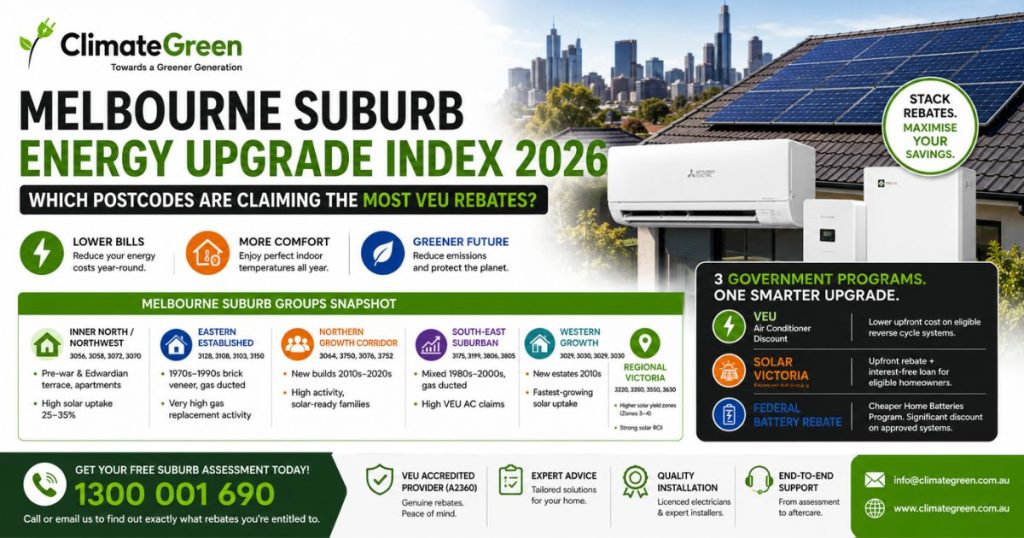
Melbourne Suburb Energy Upgrade Index 2026: Which Postcodes Are Claiming the Most VEU Rebates?
Have you ever wondered whether your suburb is one of Victoria’s biggest energy upgrade hotspots? Or whether your neighbours are already claiming rebates that you could also be eligible for?
This guide analyses Melbourne and regional Victoria’s energy upgrade activity using publicly available VEU and Solar Victoria data. It highlights where upgrades are most common, which suburbs still have the greatest untapped rebate opportunities, and why some areas are leading the way in energy-efficient home improvements.
Whether you’re planning a new reverse-cycle air conditioner, solar panels, a heat pump hot water system or a battery, this index will help you understand how your suburb compares.
📊 Data Note (Improved)
The Victorian Energy Upgrades (VEU) Registry, managed by the Essential Services Commission (ESC), publishes program activity and certificate data. Since the launch of the new VEU Registry on 3 June 2025, more detailed reporting has become publicly available.
The suburb profiles in this guide combine information from:
- Essential Services Commission (VEU activity reports)
- Solar Victoria installation statistics
- Australian Bureau of Statistics (ABS) housing and gas connection data
This combined dataset provides an overview of where energy upgrades are occurring and where future demand is likely to grow.
Eastern Suburbs (Improved)
Eastern Suburbs – Box Hill, Glen Waverley & Doncaster
Melbourne’s eastern suburbs represent one of Victoria’s largest opportunities for replacing ageing gas ducted heating systems.
Many homes in Box Hill, Glen Waverley, Doncaster, Balwyn and Templestowe were built between the 1970s and 1990s, when gas ducted heating was the standard choice for new homes. Today, many of these systems are reaching the end of their lifespan, making them ideal candidates for replacement under the Victorian Energy Upgrades (VEU) program.
Solar adoption has also increased significantly across the region. Solar Victoria data shows steady year-on-year growth in solar installations, particularly in postcodes 3128 (Box Hill) and 3150 (Glen Waverley).
Because many households in these suburbs fall within medium-to-higher income brackets, homeowners should also be aware of the updated Solar Victoria income threshold, which reduces to $150,000 from July 2026.
If your home still relies on an ageing gas ducted heating system, this area offers some of the strongest VEU rebate opportunities currently available.
Northern Growth Corridor (Improved)
Northern Growth Corridor – Craigieburn, Wollert & Epping
Melbourne’s northern growth corridor is one of Victoria’s fastest-growing residential regions and continues to record strong demand for energy-efficient home upgrades.
Large numbers of homes built from 2012 onwards were connected to natural gas during construction. As these properties age, many are becoming eligible for VEU-supported upgrades, particularly once they satisfy the program’s minimum property age requirements.
The area also enjoys excellent solar adoption rates. Large roof spaces, owner-occupied family homes and increasing electricity costs have encouraged many households to invest in rooftop solar.
With the introduction of the federal battery incentive, many homeowners are now adding battery storage to existing solar systems, making the solar-plus-battery combination increasingly popular throughout Melbourne’s north.
South-East Melbourne (Improved)
South-East Melbourne – Dandenong, Frankston & Casey
The Casey and Frankston regions continue to be among Melbourne’s highest-volume areas for VEU activity.
Much of the housing stock was built during the 1980s, 1990s and early 2000s, when gas ducted heating was the preferred heating solution. As these systems age, homeowners are increasingly replacing them with energy-efficient electric alternatives.
For many families in these suburbs, reducing household energy bills remains a key motivation, making government rebates particularly valuable.
Solar Victoria data also consistently ranks Casey among the state’s leading council areas for Solar Homes Program installations.
Western Growth Corridor (Improved)
Western Growth – Tarneit, Point Cook & Werribee
Melbourne’s western suburbs continue to experience some of the fastest growth in solar installations across Victoria.
According to Solar Victoria data, Wyndham and Hobsons Bay have recorded strong year-on-year increases in rooftop solar installations, supported by large family homes, favourable roof space and growing interest in reducing electricity costs.
This region is also well suited to combining:
- Solar panels
- Reverse-cycle air conditioning
- Home battery systems
Because the federal battery rebate does not include an income test, many households in Melbourne’s west are choosing to complete several upgrades at the same time.
Property Assessment (Improved)
How to Find Out What Rebates Apply to Your Home
While suburb trends provide a useful guide, every property is different.
The rebates available to you depend on several factors, including:
- your current heating or hot water system
- whether your home uses natural gas
- the age of your property
- your location
- current VEEC market prices
- product eligibility requirements
A property-specific assessment is the most accurate way to determine what incentives may apply.
Climate Green offers free, no-obligation assessments across metropolitan Melbourne and regional Victoria.
Simply call 1300 001 690 or email info@climategreen.com.au with your suburb and a brief description of your current heating or cooling system. Our team will explain the rebates that may be available before you commit to an installation.