
FOX ESS Home Battery Storage in Melbourne: 15kWh, 28kWh and 42kWh Options Explained
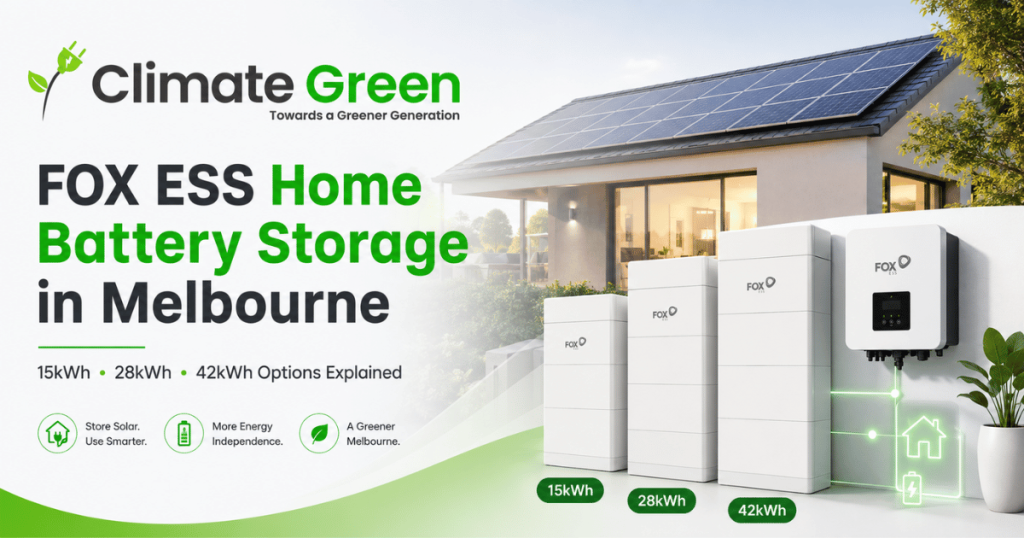
FOX ESS Home Battery Storage in Melbourne: 15kWh, 28kWh and 42kWh Options Explained
Limited stock offers available through Climate Green until 31 July 2026, subject to availability, system suitability and installation requirements.
Installing a home battery is no longer simply about keeping the lights on during a blackout. For many Melbourne households, battery storage is now part of a broader plan to use more rooftop solar, reduce evening grid purchases and prepare the home for electric heating, cooling, hot water and vehicle charging.
Climate Green currently offers FOX ESS battery solutions across three popular capacity categories:
- Approximately 15kWh home battery storage
- Approximately 28kWh home battery storage
- Approximately 42kWh home battery storage
Each size solves a different household energy problem. The best choice is not automatically the largest battery. It is the system that matches your solar production, evening consumption, peak electrical loads and future plans.
Important Note About Advertised Battery Capacity
Home battery systems are commonly promoted using rounded capacity labels such as 15kWh, 28kWh or 42kWh.
FOX ESS batteries use modular configurations, so the exact nominal and usable capacity shown on your final quotation may differ slightly from the rounded marketing name. For example, the FOX ESS EQ4800 uses 4.66kWh modules and is scalable to 41.93kWh, while the FOX ESS CQ6 range officially spans 11.98kWh to 83.86kWh. The precise model, module count, nominal capacity and usable capacity should always be confirmed in writing before installation.
Why More Melbourne Homes Are Adding Battery Storage
A rooftop solar system usually produces the most electricity during daylight hours. Household consumption, however, often increases in the evening when people return home, prepare meals, heat or cool rooms, use hot water and charge devices.
Without a battery, unused daytime solar may be exported to the grid. Later, the household purchases electricity back from the grid when solar generation has reduced.
A correctly designed battery can help a household:
- Store surplus daytime solar
- Use stored energy after sunset
- Increase solar self-consumption
- Reduce exposure to peak electricity tariffs
- Support selected appliances during a blackout when backup equipment is included
- Prepare for reverse-cycle heating, heat-pump hot water or EV charging
A battery can also be added to many existing solar systems, although inverter compatibility, switchboard condition, electrical compliance and available installation space must be assessed first.
For a detailed retrofit explanation, read:
Adding Batteries to Your Existing Solar System
Which FOX ESS Battery Size Is Right for Your Home?
Approximately 15kWh Home Battery Storage
A battery in the 15kWh category may suit households that already have solar and want to cover a meaningful portion of their evening and overnight electricity use without moving immediately to a very large storage system.
It may suit:
- Couples and small-to-medium families
- Homes with moderate evening consumption
- Households using reverse-cycle heating or cooling selectively
- Homes considering future electrification
- Customers wanting a practical balance between capacity and upfront cost
- Solar owners who currently export significant daytime energy
What problem does it solve?
The 15kWh category is designed to address the common gap between daytime solar generation and evening household demand.
It may provide enough capacity to support lighting, refrigeration, entertainment, cooking and selected heating or cooling loads, depending on the household’s consumption and system setup.
A 15kWh battery should not be selected only because it is a popular size. Climate Green recommends reviewing interval meter data and solar production before confirming whether this capacity is sufficient.
Read more:
Solar Battery Size Guide for Melbourne: 5kWh vs 10kWh vs 15kWh
Approximately 28kWh Home Battery Storage
A battery in the 28kWh category is generally aimed at larger households or homes with higher evening and overnight electricity demand.
It may suit:
- Larger family homes
- Households with extensive reverse-cycle heating and cooling
- Homes with heat-pump hot water
- Properties with larger rooftop solar systems
- EV owners or households planning to purchase an electric vehicle
- Families wanting greater overnight coverage
- Homes aiming to reduce grid use more aggressively
What problem does it solve?
A smaller battery may regularly empty before the morning in a household with substantial electrical loads.
The 28kWh category provides additional capacity for homes where several appliances operate at the same time or where electricity consumption continues throughout the night.
It may also suit households transitioning away from gas. Replacing gas heating, hot water and cooking with electric alternatives can significantly change the household’s consumption profile, so the battery should be sized for the future home rather than only the home’s current electricity bill.
Approximately 42kWh Home Battery Storage
A battery near the 42kWh category is a high-capacity residential solution.
It may suit homes with significant solar production, high daily electricity consumption or a strong requirement to retain more stored energy for evenings, overnight use and selected backup loads.
It may suit:
- Large all-electric homes
- High-consumption families
- Properties using several large electrical appliances
- Homes with multiple air-conditioning zones
- Households with one or more EVs
- Customers seeking extended backup capability
- Small home businesses with substantial daytime or evening loads
- Properties with larger solar arrays and high surplus generation
What problem does it solve?
A 42kWh system is designed for households where moderate battery capacities are unlikely to meet the required demand.
However, installing a large battery without enough solar generation or daily consumption can leave much of the capacity unused. That can weaken the financial case for the upgrade.
Before recommending this size, Climate Green considers:
- Daily electricity consumption
- Evening and overnight consumption
- Solar-system output
- Seasonal changes
- EV charging plans
- Electric heating and hot-water loads
- Backup requirements
- Single-phase or three-phase supply
- Inverter power limits
The FOX ESS EQ4800 platform is modular and officially scalable to 41.93kWh. Its Australian datasheet lists lithium iron phosphate chemistry, high-voltage operation, IP65 protection and modular expansion.
15kWh vs 28kWh vs 42kWh: Quick Comparison
| Battery category | Generally worth considering for | Main objective |
|---|---|---|
| Approximately 15kWh | Small-to-medium households with moderate evening use | Cover common evening loads and improve solar self-consumption |
| Approximately 28kWh | Larger families, electric heating, heat pumps and EV plans | Provide greater overnight coverage and support higher household demand |
| Approximately 42kWh | High-consumption or substantially electrified properties | Store larger solar surpluses and support extended energy requirements |
These are general starting points, not automatic recommendations. The final capacity should be calculated using property-specific consumption and solar data.
Key FOX ESS Battery Features
Modular and Expandable Design
FOX ESS offers modular battery platforms that can be configured at different capacity levels. The EQ4800 is built around 4.66kWh modules and scales to 41.93kWh, while the CQ6 platform has a published range from 11.98kWh to 83.86kWh.
This modular structure allows installers to create a configuration that better matches the household’s requirements.
Expansion should still be planned carefully. Under federal battery rules, only one eligible battery-system claim is generally available per premises, and later additions may not receive the same incentive if the original system has already claimed STCs.
Lithium Iron Phosphate Chemistry
The EQ4800 datasheet identifies lithium iron phosphate, or LiFePO₄, battery chemistry. This chemistry is widely used in stationary home storage applications because of its thermal stability and long-life characteristics.
High-Voltage Architecture
FOX ESS provides high-voltage battery systems designed to operate with compatible hybrid inverters. High-voltage architecture can support efficient energy transfer, although actual system efficiency depends on the complete configuration.
Integrated FOX ESS Ecosystem
FOX ESS batteries are particularly attractive for customers who want the battery, hybrid inverter and monitoring platform to operate within one manufacturer’s ecosystem.
This can simplify:
- Equipment compatibility
- Monitoring
- System commissioning
- Future troubleshooting
- Battery and inverter communication
Backup Capability
FOX ESS systems can support backup functionality when configured with compatible inverter and backup equipment.
A battery does not automatically power the entire home during an outage. Backup performance depends on:
- Inverter output
- Backup gateway or changeover equipment
- Essential-load circuit design
- Battery state of charge
- Appliance starting loads
- Single-phase or three-phase configuration
Customers requiring blackout protection should request this specifically before accepting the quotation.
Indoor or Outdoor Installation Options
Installation suitability varies by product. The EQ4800 datasheet lists IP65 protection and indoor or outdoor installation capability, subject to manufacturer instructions, electrical standards and site conditions.
FOX ESS Compared With Other Battery Brands
No battery brand is automatically the best for every property.
The right choice depends on inverter compatibility, desired capacity, future expansion, backup requirements, available space and budget.
FOX ESS vs GoodWe
FOX ESS generally stands out for high-capacity modular storage and close integration with FOX ESS hybrid inverters.
GoodWe is also a strong integrated battery-and-inverter ecosystem and may appeal to households wanting an all-in-one-style solution or already using a compatible GoodWe inverter.
FOX ESS may be more attractive when the household wants:
- Larger modular capacity
- A FOX ESS inverter and battery ecosystem
- Future expansion within the same platform
- A high-voltage storage configuration
Read the full comparison:
GoodWe vs FOX ESS Solar Batteries
FOX ESS vs SOFAR
Both brands offer modular storage, monitoring and backup-compatible solutions.
FOX ESS may appeal to customers prioritising high-capacity expansion and an integrated FOX ecosystem. SOFAR may appeal to homeowners comparing different all-in-one configurations, inverter options and price points.
Read more:
SOFAR vs FOX ESS Battery Melbourne
FOX ESS vs Dyness
Dyness is commonly considered for retrofit projects because some models work with a broader range of compatible inverter brands.
FOX ESS is often selected for new solar-and-battery projects where the homeowner wants the inverter, battery and monitoring platform from the same manufacturer.
Read more:
Dyness Batteries vs FOX ESS Batteries
FOX ESS vs Growatt
Growatt can be an attractive value-focused option for small and medium households.
FOX ESS may better suit customers requiring larger battery capacities, high-voltage modular storage or closer integration with a FOX ESS hybrid inverter.
Read more:
Growatt vs FOX ESS Solar Batteries
The comparison should focus on the complete installed system rather than the battery cabinet alone. Inverter output, backup design, monitoring, warranty conditions and installer support can be just as important as storage capacity.
Federal Battery Support in 2026
The Australian Government’s Cheaper Home Batteries Program provides an upfront discount of around 30% for eligible small-scale battery installations between 5kWh and 100kWh nominal capacity. The battery must be connected to a new or existing eligible solar PV system.
Key eligibility conditions include:
- The battery must be new
- The system must be connected to eligible solar PV
- Nominal battery capacity must generally be between 5kWh and 100kWh
- The battery must be on the approved product list
- Installation must comply with relevant Australian standards
- The installer must hold appropriate Solar Accreditation Australia battery accreditation
- Grid-connected equipment must be technically capable of VPP participation
- Only the first 50kWh of usable battery capacity can generate STCs
Battery systems installed only to charge from the grid, without eligible solar PV, do not qualify.
The final incentive value can change because it depends on usable capacity, STC calculations, installation date and market conditions. Eligibility should be confirmed before installation.
For a broader explanation of available programs, read:
VEU vs Solar Victoria vs Federal Battery Rebate: Which Programs Can You Stack in 2026?
Can a FOX ESS Battery Be Added to Existing Solar?
In many cases, yes.
The installation approach depends on the existing inverter and system condition.
Climate Green assesses:
- Existing inverter make and model
- Whether the inverter is battery-ready
- Solar-array size
- Current export settings
- Switchboard condition
- Meter and network requirements
- Available installation area
- Customer backup requirements
An older or incompatible inverter may need to be replaced with a compatible hybrid inverter. In other cases, an AC-coupled configuration may be possible.
The federal program allows eligible batteries to be connected to either new or existing solar PV systems, provided all technical and compliance conditions are satisfied.
Why Choose Climate Green?
Choosing a home battery is not simply a product-selection exercise. The system must be designed around the property.
Climate Green provides:
Property-Specific Battery Sizing
The team reviews consumption, solar production and future electrification plans rather than recommending the same battery size to every household.
Complete Solar and Battery Design
Climate Green can assess the battery, inverter, rooftop solar, backup circuits and switchboard as one integrated system.
Rebate and Compliance Support
Eligible federal battery discounts can be applied through the appropriate STC process, subject to all program conditions.
Appropriately Accredited Installation
Eligible federal installations must use a Solar Accreditation Australia-accredited installer with the appropriate battery endorsement.
Multiple Capacity Options
Customers can consider approximately 15kWh, 28kWh and 42kWh storage categories instead of being pushed into a single fixed package.
Whole-Home Electrification Advice
Climate Green can consider future upgrades such as:
- Reverse-cycle air conditioning
- Heat-pump hot water
- EV charging
- Larger rooftop solar
- Battery expansion
- Backup-power requirements
Climate Green is also a VEU Accredited Provider, Accreditation No. A2360, supporting eligible Victorian households with broader home-energy upgrades.
Frequently Asked Questions
Is a 42kWh battery too large for a normal home?
It may be.
A 42kWh battery generally makes more sense for a high-consumption household, a substantially electrified home, an EV owner or a property with enough solar generation to recharge it regularly.
A large battery that remains partly unused may not deliver better value than a properly sized smaller system.
Is a 15kWh battery enough for a family?
It can be, depending on evening consumption, appliance use and solar generation.
A family with electric heating, hot water and EV charging may require more capacity than a household using gas for several major appliances.
Can I install a battery without solar panels?
A battery can technically charge from the grid in some configurations, but a battery installed without an eligible solar PV system does not qualify under the federal Cheaper Home Batteries Program.
Will the battery run my home during a blackout?
Only when the system is designed with compatible backup equipment and appropriate circuits.
Ask whether the quote includes:
- Backup gateway
- Essential-load circuits
- Whole-home or partial backup
- Maximum backup output
- Black-start capability
- Three-phase backup limitations
Can I expand the battery later?
Some FOX ESS platforms are technically expandable. However, later additions must meet manufacturer rules and electrical standards, and additional capacity may not qualify for STCs once a previous battery claim has been made at the premises.
Does a bigger battery need a bigger inverter?
Not always, but inverter power determines how quickly the battery can charge or discharge and how many appliances it can support simultaneously.
Battery capacity is measured in kilowatt-hours, while inverter output is measured in kilowatts. Both must be assessed together.
How do I know which capacity I need?
The best starting point is your smart-meter interval data.
Climate Green can review:
- Daytime imports
- Solar exports
- Evening consumption
- Overnight base load
- Seasonal heating and cooling
- Future EV or appliance plans
FOX ESS Battery Stock Offer
Climate Green currently has selected FOX ESS home battery options available across approximately:
- 15kWh storage
- 28kWh storage
- 42kWh storage
Promotional discounts are available on selected stock until 31 July 2026, unless allocated earlier.
Final capacity, inverter model, backup functionality, product warranty, federal incentive and installation price will be confirmed after assessment.
Request a Free Battery Assessment
Send Climate Green:
- Your suburb
- A recent electricity bill
- Your existing solar-system size
- Your inverter brand and model
- Whether you want blackout backup
- Any future plans for an EV, heat pump or electric heating
📞 1300 001 690
📧 info@climategreen.com.au
🌐 www.climategreen.com.au
Terms, conditions, product availability, network approval, site requirements and government-program eligibility apply. Battery sizes used in promotional material may be rounded; refer to the final quotation for exact nominal and usable capacity.
Related Climate Green Guides
- FOX ESS CQ6 High-Voltage Battery Guide
- Adding Batteries to Your Existing Solar System
- Solar Battery Size Guide for Melbourne
- GoodWe vs FOX ESS Solar Batteries
- SOFAR vs FOX ESS Battery Melbourne
- Dyness Batteries vs FOX ESS Batteries
- Growatt vs FOX ESS Batteries
- VEU vs Solar Victoria vs Federal Battery Rebate