How Rooftop Solar Changes the Running Cost of Your Air Conditioning in Melbourne — A Winter 2026 Analysis
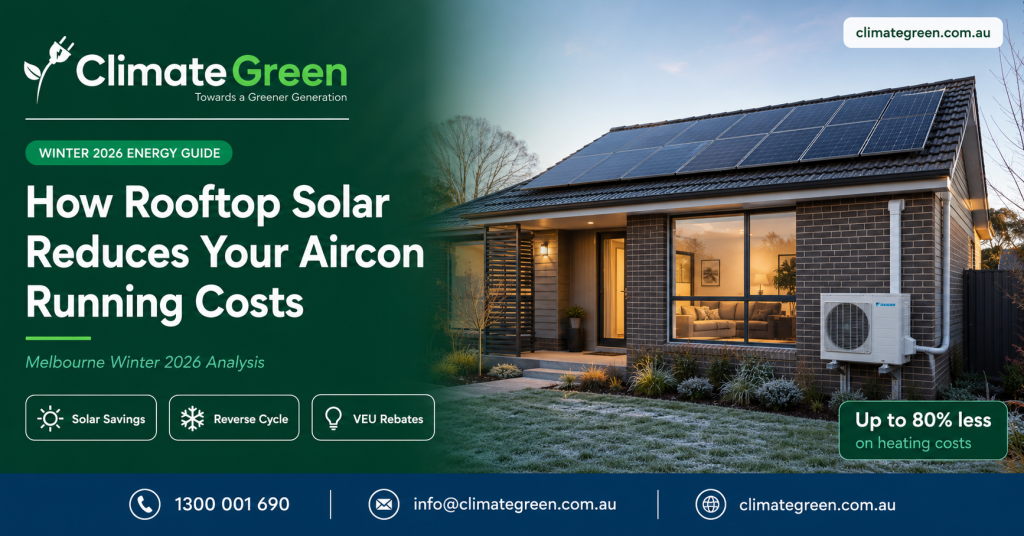
By Climate Green | Energy Efficient Solutions Victoria | Rooftop Solar Reduces Air Conditioning Running Costs in Melbourne
Published: May 2026 | Updated: May 2026
Estimated reading time: 9 minutes
Why More Melbourne Homeowners Are Looking at Solar + Reverse Cycle Heating
As Melbourne heads into another cold winter, many households are asking the same question:
“If I install rooftop solar and a reverse cycle air conditioner together, how much could I actually save on heating costs?”
The answer is often more significant than people expect.
With electricity prices remaining high and gas costs continuing to rise across Victoria, more homeowners are switching to:
- Reverse cycle heating
- Rooftop solar systems
- Battery storage solutions
Together, these upgrades can dramatically reduce winter heating costs while improving overall home energy efficiency.
This guide explains:
- How rooftop solar works with reverse cycle air conditioning
- Realistic winter running costs in Melbourne
- Government rebates available in Victoria
- What affects your actual savings
- Important terms and conditions homeowners should understand
Melbourne’s Current Energy Landscape in 2026
Victoria continues to lead Australia in rooftop solar adoption.
Recent industry estimates suggest around 35–40% of Victorian households now have rooftop solar installed, driven by:
- Rising electricity prices
- Solar Victoria rebates
- Improved solar technology
- Long-term energy savings
At the same time, electricity tariffs remain a major concern for homeowners.
The Victorian Default Offer (VDO), set annually by the Essential Services Commission, currently benchmarks electricity usage at approximately:
| Charge Type | Approximate Cost |
|---|---|
| Usage Charge | 26.6 cents per kWh |
| Daily Supply Charge | 98 cents per day |
These figures form the basis for calculating potential solar savings.
Why Solar and Reverse Cycle Heating Work So Well Together
A reverse cycle air conditioner runs on electricity.
Without solar, that electricity comes directly from the grid.
With rooftop solar installed, your air conditioner can instead use electricity generated by your own solar panels during daylight hours.
This is why the combination works so effectively.
In Melbourne:
- Solar panels generate the most electricity between 9am and 3pm during winter
- Reverse cycle systems running during these hours can operate largely on solar power
- This reduces your reliance on expensive grid electricity
For homeowners who pre-heat their homes during the day, the savings can be substantial.
Important Reality Check: Solar Does Not Eliminate All Heating Costs
One of the most common misunderstandings is that rooftop solar powers heating all night.
That is not how standard solar systems work.
Without battery storage:
- Solar panels only generate electricity during daylight hours
- Night-time heating still draws electricity from the grid
- Evening heating costs still apply at your normal electricity tariff
Battery storage can help reduce evening grid usage, but even batteries have limits.
What Does Reverse Cycle Heating Actually Cost in Winter?
Let’s look at realistic Melbourne winter heating costs for a medium-sized home.
Scenario 1 — Reverse Cycle Heating Without Solar
A typical 6kW reverse cycle system heating a 160–200m² Melbourne home may use approximately:
- 154kWh of electricity per month during winter
Using Melbourne’s benchmark VDO tariff of 26.6 cents/kWh:
154×0.266≈41
This equals roughly:
- $41 per month
- Around $123 across winter
Compare That to Gas Heating
According to industry energy analysis, a family using ducted gas heating through winter may spend approximately:
- $800–$1,000+ across winter
This difference is one of the major reasons Victorian households are replacing older gas systems with reverse cycle heating.
Scenario 2 — Reverse Cycle Heating with Rooftop Solar
Now let’s add rooftop solar into the equation.
A well-positioned 6.6kW solar system in Melbourne can generate enough daytime electricity during winter to offset much of the reverse cycle system’s daytime usage.
This means:
- Midday heating may operate almost entirely on solar electricity
- Grid electricity usage drops significantly
- Running costs become much lower
In practical terms:
- Reverse cycle heating during solar generation hours may cost close to zero from the grid perspective
Why Using Solar Electricity Yourself Is More Valuable
Victoria’s solar feed-in tariffs generally range between:
- 4–7 cents per kWh
However, buying electricity from the grid costs around:
- 26.6 cents per kWh
That means:
- Using your solar electricity directly inside your home is worth far more than exporting it to the grid
Running your reverse cycle system during daylight hours is one of the most effective ways to maximise solar value.
Scenario 3 — Solar + Battery Storage
Adding battery storage extends your ability to use solar electricity into the evening.
A typical 10kWh battery may help power heating for several additional evening hours before drawing electricity from the grid.
However, battery systems do have limitations:
- Heavy overnight heating can still exhaust stored energy
- Full-night heating generally still requires some grid electricity
Realistically, a solar + battery setup may reduce winter heating grid dependence by:
- Approximately 60–80%
Government Rebates Available in Victoria
Victorian homeowners may be eligible for several energy upgrade incentives.
Victorian Energy Upgrades (VEU) Program
The Victorian Energy Upgrades (VEU) program provides discounts for eligible reverse cycle air conditioning installations.
Eligible upgrades may include:
- Replacing older gas ducted systems
- Installing high-efficiency reverse cycle systems
- Multi-head split systems
- Energy-efficient heating and cooling upgrades
Important Conditions
- The system must be VEU-approved
- Installation must be completed by an accredited provider
- Minimum customer co-payments apply
- The property must be located in Victoria
- Warranty requirements apply under VEU rules
Climate Green provides fully itemised quotes with all applicable discounts clearly shown.
Solar Victoria Rebates
Eligible Victorian homeowners may also access:
- Rooftop solar rebates
- Interest-free loan options
- Additional battery incentives (subject to program availability)
Eligibility may depend on:
- Household income
- Property ownership status
- Program funding availability
Federal Battery Incentives
Battery installations may also qualify for incentives through federal small-scale renewable energy schemes.
Battery rebate values can vary depending on:
- Market certificate pricing
- Battery size
- Installation date
- Approved product eligibility
What Could a Combined Upgrade Look Like?
For a Melbourne household upgrading from gas heating to:
- Reverse cycle air conditioning
- Rooftop solar
- Optional battery storage
Potential outcomes may include:
✅ Lower winter heating costs
✅ Reduced electricity bills
✅ Elimination of gas supply charges
✅ Improved year-round comfort
✅ Lower carbon emissions
✅ Government rebate savings
Many households see winter heating costs reduce dramatically compared to older gas systems.
What Affects Your Actual Savings?
Every home is different.
Actual savings depend on several important factors.
Roof Direction & Shading
North-facing roofs with minimal shading generally produce the highest solar output.
Heavy shading reduces performance significantly.
Winter Solar Generation
Solar output during Melbourne winter is much lower than summer production.
Shorter daylight hours affect daily generation totals.
Heating Usage Habits
Households using heating mainly during daylight hours benefit most from solar.
Night-time usage relies more heavily on grid electricity.
Electricity Tariff
Your electricity retailer and tariff plan strongly affect actual running costs.
Some households pay significantly more than the VDO benchmark.
Home Design & Insulation
Factors such as:
- Ceiling insulation
- Window size
- Ceiling height
- Draft sealing
- Home orientation
all affect heating efficiency.
Frequently Asked Questions
Can rooftop solar fully power my air conditioner?
During daylight hours, potentially yes — depending on solar generation and system size.
At night, electricity generally comes from the grid unless battery storage is installed.
Does having solar affect VEU eligibility?
No. Solar and VEU programs operate independently.
What size solar system is best for heating savings?
Many Melbourne households install systems between:
- 6.6kW and 10kW
However, ideal sizing depends on:
- Home size
- Energy usage
- Roof space
- Heating patterns
Is reverse cycle heating cheaper than gas?
In many Melbourne homes, yes.
Reverse cycle systems are significantly more energy efficient than traditional ducted gas heating.
Can Climate Green help with both solar and air conditioning?
Yes. Climate Green provides:
- Solar installation
- Reverse cycle air conditioning
- Heat pump solutions
- Government rebate assistance
- Energy efficiency advice
Final Thoughts
For many Melbourne homeowners, combining rooftop solar with reverse cycle heating is becoming one of the smartest long-term energy upgrades available.
The combination can help:
- Reduce winter heating costs
- Improve comfort
- Lower energy bills
- Reduce reliance on gas
- Increase household energy efficiency
However, every home is different.
The best results come from properly designed systems, realistic expectations, and professional advice tailored to your property.
Speak with Climate Green
📞 1300 001 690
📧 info@climategreen.com.au
🌐 climategreen.com.au
Melbourne & Victoria | Energy Efficient Solutions
Disclaimer
All savings figures, rebate information, electricity tariffs, and running cost estimates mentioned are indicative only and based on publicly available information current at May 2026. Actual results vary depending on property characteristics, solar generation, usage patterns, tariff plans, weather conditions, VEEC market pricing, and individual household circumstances. Terms and conditions apply.