How Government Policies Are Pushing Victoria Toward All-Electric Homes
Victoria is undergoing one of the most significant residential energy transformations in its history. Across Melbourne and regional Victoria, homeowners are increasingly moving away from gas and embracing all-electric homes powered by solar, batteries, heat pumps, and energy-efficient air conditioning.
This shift isn’t accidental. It’s being actively shaped by state and federal government policies, rebate programs, building regulations, and long-term climate targets that are accelerating the transition to cleaner, smarter energy.
For Victorian households, understanding why this change is happening — and how to benefit from it — has never been more important. Read All about the Government Energy Policies
Why Victoria Is Moving Away from Gas
Gas has long been a staple in Victorian homes for heating, hot water, and cooking. However, government research now clearly shows that gas is:
- A major contributor to household emissions
- Becoming more expensive due to infrastructure and supply costs
- Inconsistent with Victoria’s net-zero targets
Victoria has legislated net-zero emissions by 2045, and residential energy use plays a major role in achieving this goal. Homes powered by electricity — especially when paired with renewable energy — significantly reduce emissions while improving efficiency and affordability.
As a result, government policy is now focused on phasing down gas reliance rather than expanding it.
Key Victorian Policies Driving All-Electric Homes
1. Victorian Energy Upgrades (VEU) Program
The VEU program is one of the strongest policy tools pushing households toward electrification. It provides incentives for replacing inefficient or gas-based systems with high-efficiency electric alternatives.
Under the VEU program, Victorian households can access rebates for:
- Reverse-cycle air conditioning (heating & cooling)
- Heat pump hot water systems
- Efficient electric appliances
By reducing upfront costs, the VEU program makes switching from gas to electric both affordable and attractive for Melbourne homeowners.
2. Solar Victoria & Renewable Energy Incentives
The Solar Homes Program has already helped hundreds of thousands of Victorian households install solar panels and batteries. By generating clean electricity at home, households can power electric appliances without relying heavily on the grid.
Government incentives now strongly support:
- Rooftop solar systems
- Home battery storage
- Energy independence and self-consumption
When combined with all-electric appliances, solar energy allows Victorian homes to significantly cut power bills while reducing emissions.
3. Gas Connections Being Phased Out in New Homes
One of the clearest policy signals is the removal of mandatory gas connections in new Victorian homes. Many new developments across Melbourne are now designed as electric-only, with no gas infrastructure at all.
This means:
- New homes are future-proofed from gas price increases
- Builders are prioritising electric heating, cooling, and hot water
- Homeowners avoid long-term gas connection and supply costs
Over time, this policy will reshape Victoria’s housing stock toward all-electric living.
4. Minimum Energy Efficiency Standards
Victoria has introduced Minimum Energy Efficiency Standards (MEES), particularly affecting rental properties. These standards push landlords to upgrade inefficient heating systems and improve overall energy performance.
Electric systems — especially reverse-cycle air conditioning and heat pumps — are often the most cost-effective way to meet compliance while reducing tenant energy bills.
As standards continue to tighten, all-electric solutions are becoming the default choice.
5. Federal Climate & Energy Policy Alignment
At a national level, Australia’s climate commitments support electrification through:
- Renewable energy targets
- Support for clean energy technology
- Infrastructure planning focused on electricity, not gas
Victoria’s policies are closely aligned with these federal goals, ensuring long-term consistency for homeowners making the switch today.
What an All-Electric Home Looks Like in Melbourne
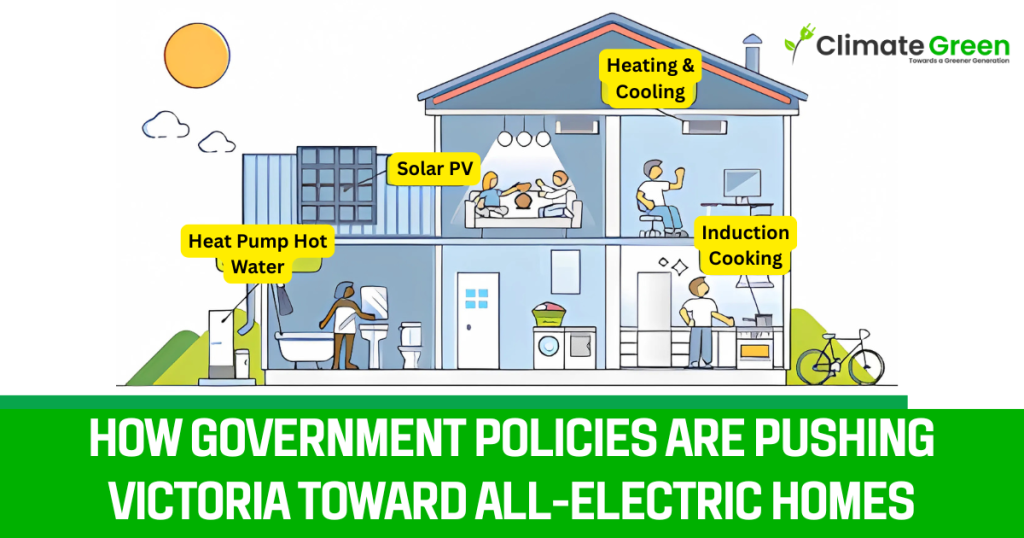
An all-electric home typically includes:
- Solar panels to generate renewable electricity
- Battery storage to use solar energy at night or during outages
- Reverse-cycle air conditioning for efficient heating and cooling
- Heat pump hot water systems replacing gas units
- Induction cooktops instead of gas stoves
These technologies are not only cleaner but also far more energy-efficient than traditional gas systems.
Cost Savings: Why Electrification Makes Financial Sense
Government policy isn’t just about emissions — it’s also about affordability.
Victorian households that switch to all-electric systems often benefit from:
- Lower energy bills over time
- Reduced exposure to volatile gas prices
- Rebates that significantly cut upfront costs
- Higher property value and buyer appeal
With solar and efficient electric appliances working together, many homes can reduce total energy costs year after year.
Why Acting Now Matters for Victorian Homeowners
Government incentives and rebate structures change over time. As demand increases, some rebates may reduce or tighten eligibility.
Acting sooner allows homeowners to:
- Access higher rebate levels
- Lock in long-term energy savings
- Avoid future compliance costs
- Transition on their own timeline, not under pressure
Early adopters are already seeing the benefits of lower bills, improved comfort, and future-ready homes.
How Climate Green Helps Melbourne Homes Go All-Electric
At Climate Green Melbourne, we help homeowners navigate the shift to all-electric living with confidence.
Our team specialises in:
- Solar panel and battery installations
- VEU-approved air conditioning systems
- Heat pump hot water solutions
- End-to-end rebate guidance and compliance support
We assess your home, explain your options clearly, and help you access the maximum rebates available, ensuring a smooth and stress-free transition.
Final Thoughts: The Future of Victorian Homes Is Electric
Government policies are sending a clear message: Victoria’s energy future is electric. With strong incentives, tightening efficiency standards, and rising gas costs, all-electric homes are becoming the smart, sustainable choice for Melbourne households.
By understanding these policies and acting early, homeowners can reduce costs, increase comfort, and play a meaningful role in Victoria’s clean energy transition.
Thinking about switching your home to electric?
📞 Call Climate Green Melbourne on 1300 001 690
📧 Email: info@climategreen.com.au
🌐 Get expert advice and a free assessment today